


- The independent film market brought together around 200 professionals in Valladolid, where they addressed the challenges facing the sector: declining audiences, overproduction and the urgent need to regulate exhibition windows
- ● The Secretary General of the ICAA announced the commitment to create the State Film Council next year and a four-year strategic plan, focusing on distribution and promotion, to serve as a forum and allow for the regulation and organisation of the market
Around 200 professionals from the audiovisual sector gathered at the fifth edition of the MERCI Independent Film Market, which took place over three days at the Broadway Cinemas in Valladolid. Organised jointly by the Valladolid International Film Festival (SEMINCI) and the Association of Independent Film Distributors (ADICINE), with the support of the Ministry of Culture, this event has established itself as the professional benchmark in Spain for promoting the circulation of independent films to audiences, bringing together programmers, exhibitors, distributors, platforms and television stations in a unique space for debate and networking.
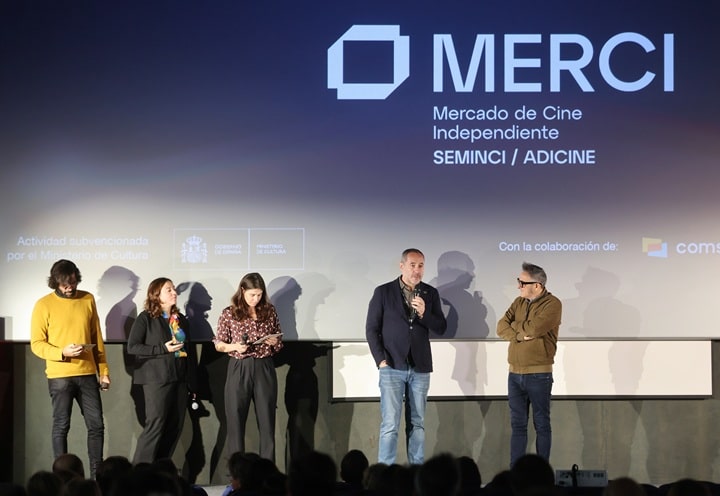
‘These spaces are increasingly essential and necessary in the audiovisual industry because they offer the possibility of bringing together important elements of the industry in one place and developing interesting projects,’ said Camilo Vázquez, deputy director general of Promotion and International Relations at the ICAA, during the opening of MERCI on 29 October.
MERCI attracts 30% more film professionals this year
Lara Pérez-Camiña and Enrique Costa, co-presidents of ADICINE, an association joined this year by distributors Atalante, Beta Fiction, LAZONA, Filmin and Sideral, confirmed that, just as ADICINE has grown, so has MERCI, with a 30% increase in attendance compared to 2024, ‘confirming its essential role in the Spanish film industry calendar.’ They added: ‘This year we have a significant number of cinema representatives, programmers and professionals from the television acquisition sector attending our market for the first time.’
ADICINE spokespersons shared the good news about box office results for the Ministry of Culture’s Tuesday Senior programme, which offers cinema tickets for two euros to people over 65 every Tuesday, and the success of Spanish productions distributed by independent companies. ‘Our association is supporting this high-quality national cinema that is taking the box office by storm, breaking down barriers and prejudices, and reaching the best festivals,’ said Costa, recalling that independent distributors account for more than 25% of the Spanish box office share thanks to films such as Deaf, Sirat, Romería, Sundays, The Dinner and Mi amiga Eva.
‘This has opened up new avenues for us and secured a position thanks to which our distributors are acquiring and financing the production of larger films, supported by general aid from the ICAA, offering exhibitors and the public the best national cinema,’ he added. Regarding the distribution of European and international films, the co-president of ADICINE also pointed to the fact that all the award-winning films at the latest Cannes Film Festival will be distributed by independent companies as a sign of the excellent situation in the sector.
According to market data subsequently provided by Comscore Movies, ADICINE’s members have earned €38 million in box office receipts in 2025 thanks to the 5.9 million viewers who have attended premieres in the cinemas of the associated distributors, with a total of 202 premiere titles and a 12% market share.
MERCI, a space for dialogue and reflection
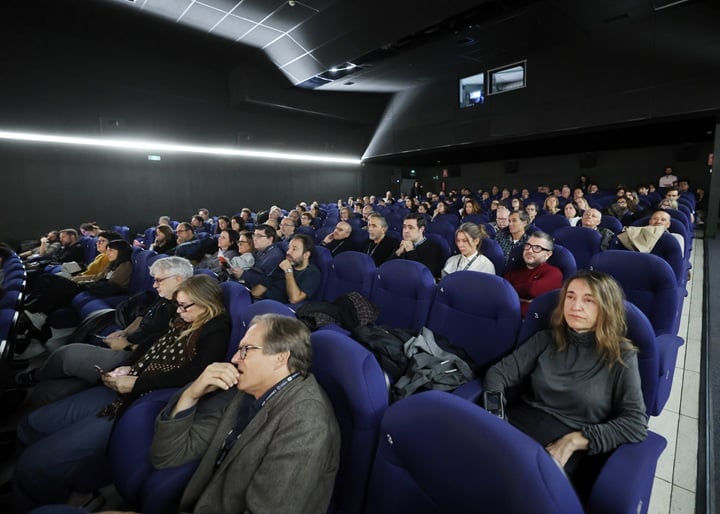
The overall picture of the film exhibition industry, however, painted a bleaker picture, marked by a steady decline in cinema audiences, overproduction of titles that undermines their viability, and a lack of necessary regulation at both national and European level.
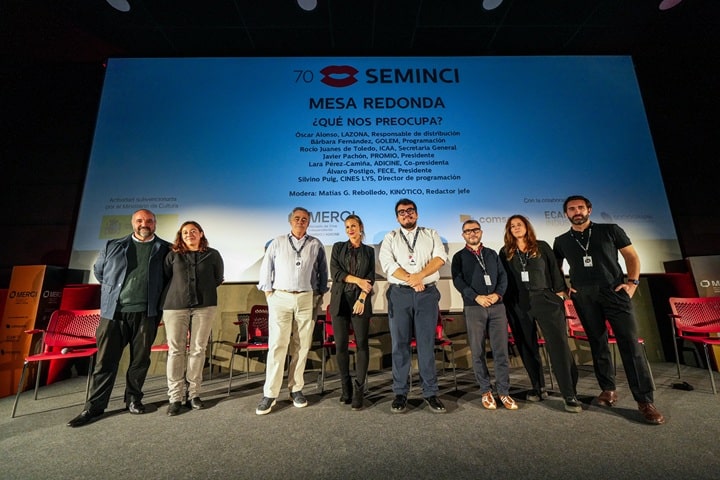
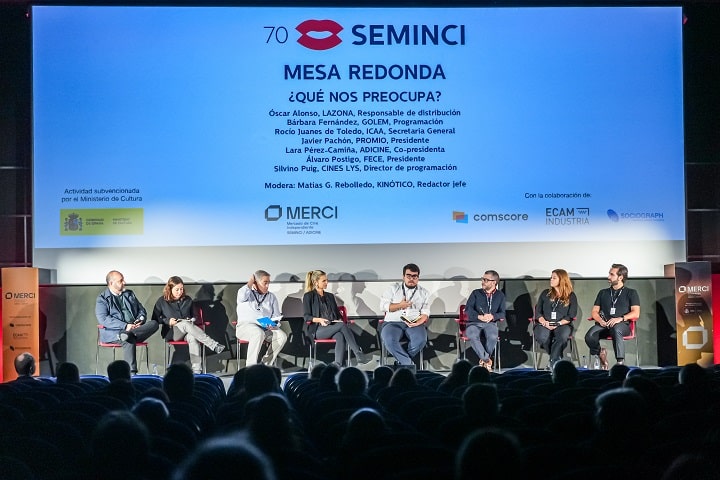
To share their views on these issues, the 70th edition of SEMINCI brought together Rocío Juanes de Toledo, secretary general of ICAA; Álvaro Postigo, president of the Spanish Cinema Federation (FECE); Javier Pachón, president of the independent cinema association PROMIO; Lara Pérez-Camiña, co-president of ADICINE; Silvino Puig, programming director at Cines Lys; and Bárbara Fernández, programmer at GOLEM. Matías G. Rebolledo, editor-in-chief of Kinótico, moderated the discussion.
The loss of audiences: a major concern for the film sector ‘The loss of viewers is worrying,’ summarised Bárbara Fernández, from the Golem Programming team. The figures confirm this: box office takings are down by two million euros compared to the same period last year, according to data provided by the director of Kinótico.
Silvino Puig, programming director at Cines Lys, confessed that ‘programming keeps him awake at night,’ while Álvaro Postigo, president of the Spanish Cinema Federation (FECE), warned about the concentration of box office revenue in just eight titles, a trend that has worsened since the pandemic and also affects independent cinema: “Audiences are losing the desire to explore.”
Overproduction: blessing or curse?
In 2024, 2,645 films have been screened in Spanish cinemas, including premieres, film forums, retrospectives and reruns. Added to this is the content available on streaming platforms and social media. The secretary general of the ICAA acknowledged that aid has focused on promoting national production, but defended this, saying: ‘It is positive because it is high quality, as demonstrated by the awards and its presence at international festivals. Spanish titles have seen a smaller drop in audience numbers than the overall figure.’ She also pointed out that, according to the Cultural Habits Survey conducted by the Ministry of Culture, 8% of the public considers that there is little on offer. It therefore announced the ICAA’s intention to focus from now on on the distribution and exhibition of this quality production, so that it reaches that audience which, according to the aforementioned survey, only sees 1.5 films a year in the cinema but, in 15% of cases, consumes one film a day at home.
Álvaro Postigo, representative of the exhibitors, also agreed that there was overproduction in Europe due to the demand for content from channels and platforms and public subsidies for production. However, he did not consider this a problem: ‘Blessed diversity, thank goodness there are so many titles.’
The exhibition window dilemma
“The exhibition window is the elephant in the room,” acknowledged the ICAA spokesperson. The short time that titles remain in cinemas makes it difficult for them to find their audience, which is why Rocío Juanes de Toledo believes promotion is essential. According to Javier Pachón, president of PROMIO, this promotion does not reach small towns, which is why he advised the need to “discover local audiences,” with exhibitors collaborating with distributors to expand the audience for each title. Oscar Alonso, from LAZONA, added that ‘getting release dates right has become essential.’
Bárbara Fernández, from Golem, had a rather pessimistic view of the future of the Spanish film industry if the situation continues: ‘We are killing films and the future of the industry. Many new filmmakers will not be able to make another film because their first one was not successful.’ She added that what exhibitors need is help to renovate their seats and invest in new technologies. ‘Give the public the best cinema experience.’
Álvaro Postigo lamented: ‘We’re not going to make it in time this year. Cinemas are going to be lost, with total or partial closures. The census is starting to be negative.’ He also called for aid comparable to that given to other audiovisual industries.
Both exhibitors and distributors called for order in the sector. Óscar Alonso was clear: ‘There is disorder. The film industry is embroiled in internal disputes with the platforms, but they are also suffering. The solution must come from the EU, bringing order from above, especially in countries with important film industries.’
‘Our American friend is absent,’ added Postigo, who warned of instability in the US market following 1,000 layoffs at Paramount and corporate mergers: ‘The worst thing that could happen to us is for Warner to fall into the hands of another studio. We would see another reduction in titles and a slowdown in planned investments.’ In his opinion, the problem outside Spain lies in the creation of powerful content that serves as a driving force to bring audiences to theatres.
In response to the sector’s demands, the ICAA’s secretary general announced a commitment to create a State Council next year and a four-year strategic plan, focusing on distribution and promotion, to serve as a forum and allow for the regulation and organisation of the market: ‘We have managed to create diverse production that breaks the gender gap. Without losing that focus, we must emphasise that this production reaches the public,’ said Rocío Juanes de Toledo.
Rejuvenating the audience
Being that the average age of cinema-goers is 40, all participants agreed on the urgent need to attract young people. Juanes de Toledo announced the ICAA’s confidence in the Cine Escuela (Film School) programme as a way of encouraging young people to get into the habit of going to the cinema: ‘Nobody can love what they don’t know,’ she said. The initiative, in which the Ministry of Culture will work together with schools, film libraries and the Film Academy, will include the selection of films, the production of educational guides, and agreements with associations that will act as intermediaries.
However, exhibitors pointed out that cinemas, like festivals, have been working with schools for years on special screenings for schoolchildren and requested that no exhibitor or distributor who applies be left out of this programme. Golem warned: ‘Young people only go to event films,’ and Javier Pachón proposed ‘creating screenings that are not just cinema, but ephemeral experiences; when we organise sessions with filmmakers or actors in attendance, the average age drops.’ In this regard, the representative of FECE and director of MK2 cinemas contributed his experience working with cultural mediators and external event producers.
Cinema’s loyal core: The senior audience
Paradoxically, seniors proved to be a strategic asset. Rocío Juanes de Toledo pointed out that the programme is well established and works particularly well with national titles: ‘On Tuesdays, 35-40% of box office takings are from Spanish cinema.’ Álvaro Postigo added that ‘senior audiences consume more diverse cinema,’ while young people concentrate on niche genres.
The Spanish film industry is thus facing a critical moment where the balance between production, distribution and exhibition has been broken and measures must be taken to save cinemas and win back lost audiences. ‘Let’s sell the experience of going to the cinema. But to do that, we need investment and unity,’ concluded Lara Pérez-Camiña.
MERCI 2025 activities programme
As part of the programme of activities aimed at accredited market professionals, in addition to the screening of 27 films scheduled for release in late 2025 and throughout 2026, film consultant Jon Barranechea, in collaboration with Europa Cinemas Lab, presented a study on cinema subscription models. With an approach that seeks to “turn competition between independent exhibitors into collaboration and growth to face broader competition in the market,” he contributed the experience of models such as MUBI GO (United States, United Kingdom, Ireland and Germany), Cineville (Netherlands, Belgium, Germany and Austria) and NONSTOP (Austria). In his opinion, cinemas need to come together in a subscription and collaboration model that is sustainable in the long term, which is ‘essential for the growth of our sector and necessary for any of these models’.
For her part, Ella Kemp, editorial and festival manager for the United Kingdom and Europe at Letterboxd, also presented the talk Cinema as a social network: the Letterboxd phenomenon via streaming.
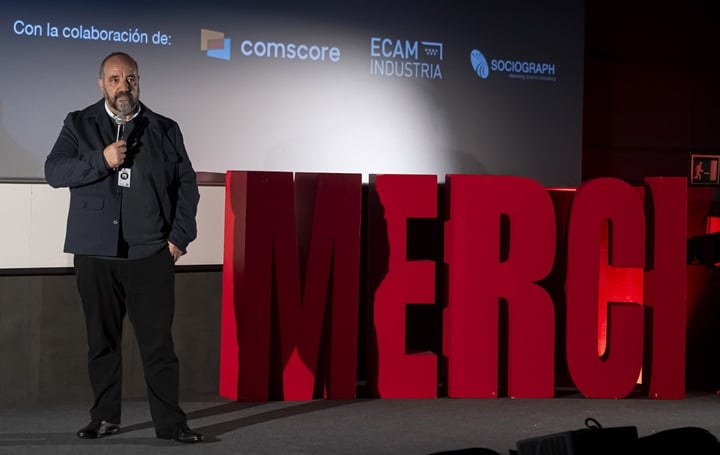
Silvino Puig, MERCI 2025 Award
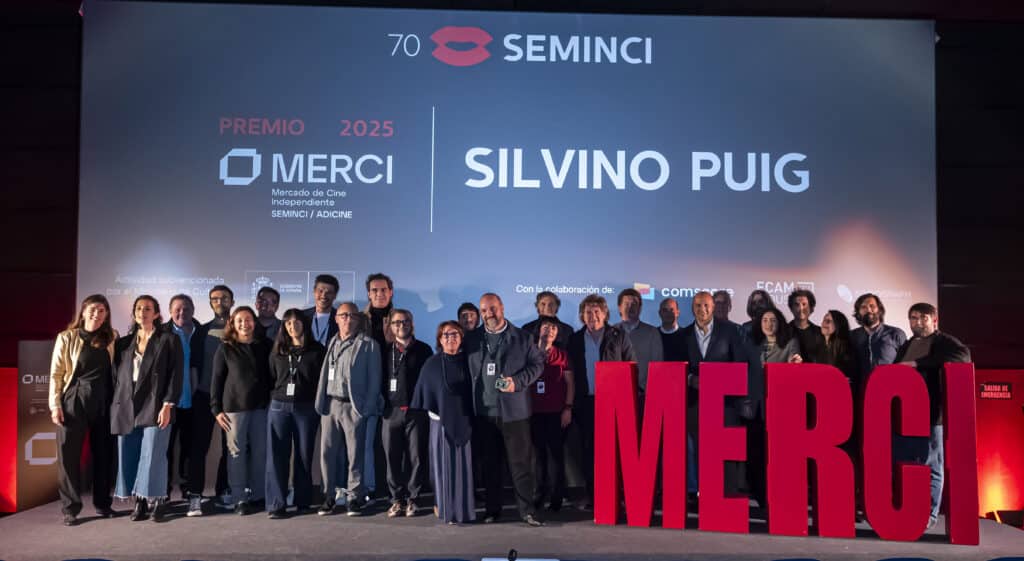
The MERCI 2025 Award recognised Silvino Puig for his extensive career as Director of Programming and General Services at Cines Lys in Valencia. Puig opened Cines Lys in Valencia in 2001 alongside Bautista Soler, and in 2006 he took over the programming of Lys and ABC Park until 2013. From 2018 onwards, he devoted all his efforts to creating projects to attract new audiences to the cinema, giving rise to initiatives such as ‘Cine Club Lys’, ‘Cita a ciegas con el cine’ and ‘Terroríficamente Lys’, proposals that have revitalised the connection between cinemas and viewers. In addition to his work in exhibition, he is a founding partner and president of Proyecto Viridiana and a founding partner of the distribution company Carácter Films, thus consolidating his comprehensive commitment to independent cinema on multiple fronts of the industry.
The exhibitor dedicated the award to his family and mentors and praised the work of independent distribution, without which, in his words, ‘it would be impossible for me to be receiving this award’. He also showed his support for the cinemas affected by the DANA a year ago in Valencia.
During the closing ceremony of the Independent Film Market, the first La Meseta Distribución awards were also presented to the promotional campaigns for the films The Chronology of Water, presented by the distributor Sideral; La buena hija, by Avalon and MadAvenue; El amor que permanece, by Elástica and Revolutionary. Beta Fiction received a special mention from the jury for its campaign for Rondallas.
About MERCI
MERCI VALLADOLID is an event organised by Seminci and ADICINE, subsidised by the Ministry of Culture, with the collaboration of COMSCORE, ECAM Industria and Sociograph. It has become the essential platform where the Spanish independent film industry meets to analyse its challenges, share experiences and build bridges between distributors, exhibitors and programmers. The fifth edition reinforces the event’s commitment to the
visibility and circulation of independent cinema in Spain. ADICINE is made up of the distributors A Contracorriente Films, Atalante, Avalon, Beta Fiction Spain, Bteam Pictures, Caramel Films, DeAPlaneta, Elastica, Festival Films, Filmax, Filmin, Golem, Karma Films, La Aventura, LAZONA, SelectaVision, Sideral, Syldavia, Tripictures and Wanda Vision.