


- The 70th edition of SEMINCI welcomes the Spanish premiere of the latest work by renowned filmmaker Bi Gan, who received the Special Jury Prize at the last Cannes Film Festival.
- The film, which stars Taiwanese film star Shu Qi, offers a sensory and temporal journey through the history of cinema in the 20th century.
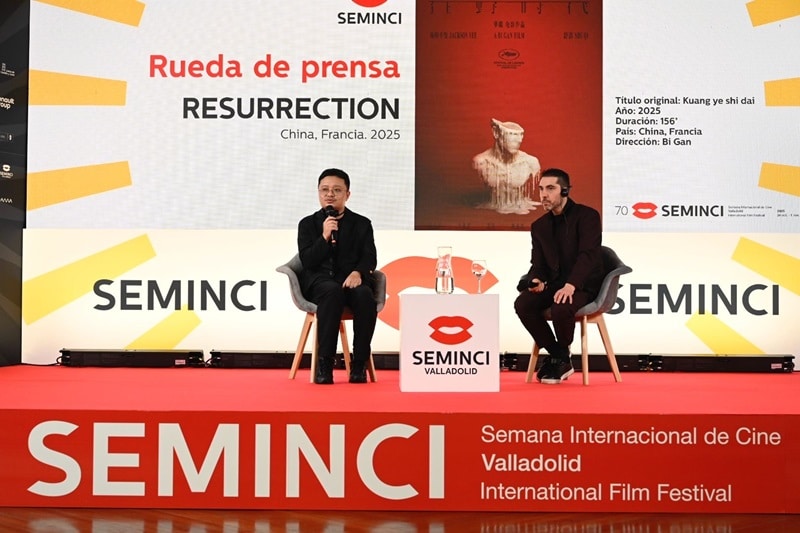
Acclaimed Chinese director Bi Gan presented his latest and most daring film, Resurrection, today in the Official Section of the 70th SEMINCI. Following the fascinating Kaili Blues (2015) and Long Day’s Journey Into Night (2018), Bi Gan returns to explore the realm of dreams, this time creating a parallel universe in which human beings have lost the ability to dream. Only a few individuals, called “delirants”, insist on keeping their dream-like ability alive, while a mysterious woman, played by the famous actress Shu Qi (Millennium Mambo, Transporter), is in charge of rescuing them from the imaginary worlds in which they wander.

A century of dreams
Ambitious and playful, Resurrection offers a journey through time and the senses, taking the form of a tribute to cinema throughout the 20th century: from its early decades, from Méliès to German expressionism, to the inclusion of new technologies in the 1990s. ‘We wanted to cover a specific period of time, starting with the beginnings of cinema and ending with the turn of the century. Each chapter corresponds to a film genre, but also to the five senses, which represent the core of my film,’ said Bi Gan.
All of this is framed within a complex episodic structure; a web of stories that, one after another, remind us of the power of fiction to invent other worlds. The filmmaker pointed out the challenges in making some episodes, including a forty-minute sequence shot: ‘Everyone had high expectations for my sequence shot, which is precisely why I didn’t want to do it at first. But it’s also the technique I’m most familiar with, and it was consistent with what we wanted to show in that final episode, the night before the new millennium.’
However, he adds that the most important thing is neither the structure nor the forms of cinema: ‘Cinema, for me, is always a game. And these are simply ways of making films. The most important thing is the ending, it’s the people who shine in the film, the emotion. Not only towards cinema but also towards the world.’
The cinema of the future
Resurrection offers a look at the past that transcends mere nostalgia and reflects on the future, both of humanity and of the art of cinema. This is particularly important given current technological advances. “We live in a world of highly advanced technology, and we depend on it completely in our daily lives. And it is normal for many authors to be concerned about the future. But we must remember that what we really need is our body. We use our legs to walk and go further, our eyes to see, our mind to think. Of course, the changing world makes us dependent on machines, but I think we need to return to traditional, ancient, pure, simple things. Our knowledge of the world seems flawed, but it is what builds our consciousness and our society; it is what makes us human,” said Bi Gan, reflecting a vision that moves away from defeatism and restores cinema’s luminosity.