


- The Brazilian filmmaker won the Grand Jury Prize at the Berlinale with “The Blue Trail,” a luminous story about old age.
The 70th edition of the Valladolid International Film Festival (SEMINCI) hosted the Spanish premiere of The Blue Trail in its Official Section. In this film, Brazilian filmmaker Gabriel Mascaro uses science fiction and fantasy to tell the story of Teresa’s unexpected journey through the Amazon at the age of 77, fleeing the nursing home to which the government forces her to move at the end of her working life: ‘I wanted to make a film about the reinterpretation of an elderly person’s life that did not deal with finitude, death or nostalgia,’ said Mascaro.
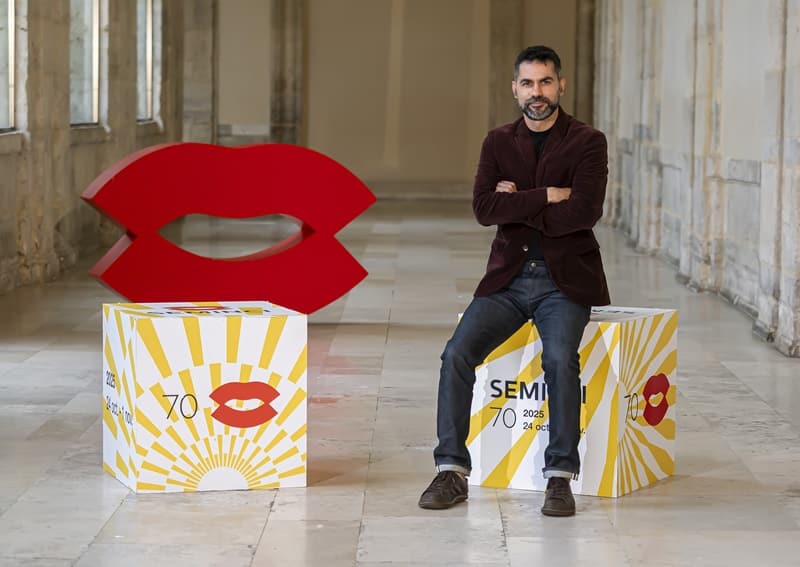
The director assured that his intention was to approach the subject from a different perspective to existing cinematic references about elderly people: ‘I think of films like Amour, by Michael Haneke (2012), or Tokyo Story, by Yasujiro Ozu (1953), works that speak precisely of how the world turns its back on the elderly and that have influenced me greatly, but from which I wanted to distance myself. I also remembered Richard Linklater‘s Before Sunrise (1995) and that chance romantic encounter. I wanted the film to be something like that; to play with this tradition, but displaced onto an elderly body as an act of resistance and transgression.’
For this quest, Mascaro found his perfect setting in the Amazon rainforest, a place the director knows deeply, having taught indigenous communities for years: ‘I wanted to delve into the enchantment of the interior of the jungle and the magical powers that lie in the fauna and flora, in winding rivers where you can get lost, but where you can also find yourself, and the imagery of the Amazon was already in my head.’
A constant game of genres
The film is constructed as a kind of dystopia, with constant formal games between the real and the fantastic that shape Teresa’s story. ‘One of the main influences was undoubtedly The Straight Story, by David Lynch,’ he acknowledged in relation to the idea of travel that shapes the film. This constant attempt to surprise was also transferred to the work with the actors: ‘I try to create little accidents to provoke the cast. Fiction cinema deals with the idea of control, but I’m very interested in having elements that break with that strategy and in unexpected things happening in the middle of filming.’

In addition, according to Mascaro, music has been one of the crucial elements in shaping this unexpected narrative: ‘The music is based on a mixture of genres that are seemingly impossible to connect, and it was the first playful act; as if there were an orchestra in the cinema communicating with the audience at all times and playing counterintuitively with what is being seen.’
This constant formal experimentation served to generate a critical foundation that helped to reflect on the present: ‘For me, it was important to think about the dilemma faced by a society that believes in productivity as the main driving force of the world. What happens to a body that no longer produces? I wanted to freely explore the possibilities of a feminine iconography of old age that is far removed from expectations,’ he assured.