

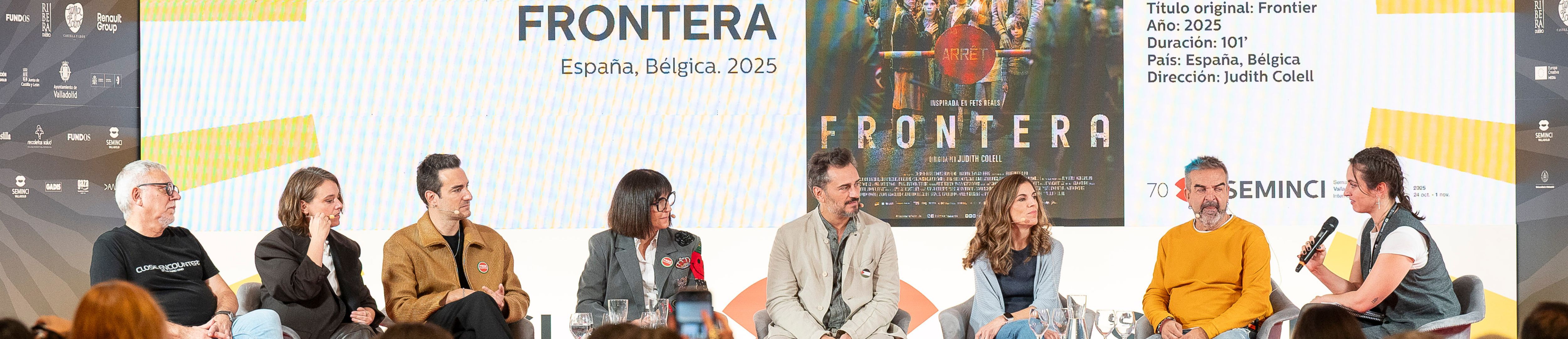
- Frontera will have its world premiere at the 70th SEMINCI, where it will participate in the Official Section. (out of competition)
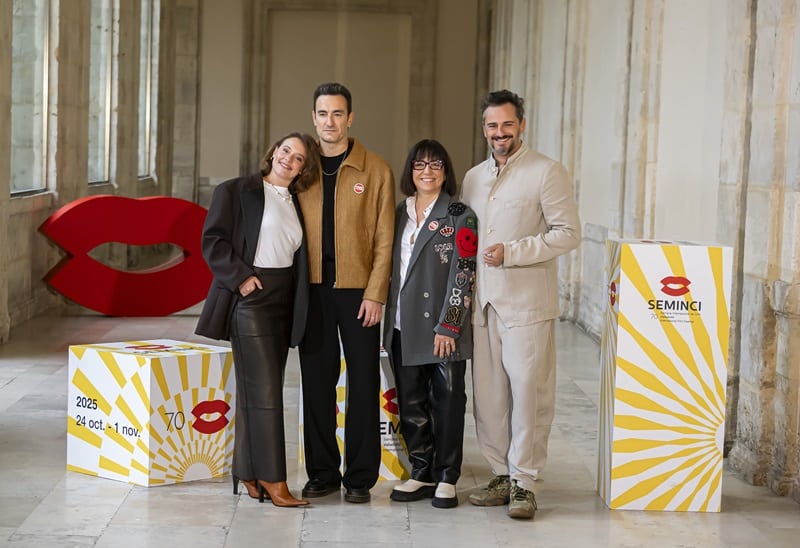
- The filmmaker and director of the Catalan Film Academy attended the festival alongside the producers and part of the cast, which includes Asier Etxeandía, Miki Esparbé and María Rodríguez Soto.
Catalan director, screenwriter and producer Judith Colell presented the world premiere of Frontera at the 70th Seminci, with a cast that includes Miki Esparbé, María Rodríguez Soto, Asier Etxeandía, Bruna Cusí, Jordi Sánchez and Kevin Janssens.
Frontera is set in 1943 and recounts the little-known story of a group of inhabitants of a village in the Pyrenees who defied the rules of Franco’s regime to save hundreds of refugees arriving from France, fleeing the Nazi regime. A story that reflects the reality of 45,000 people who risked their lives to reach the Atlantic coast and seek new horizons on the American continent.
Period film
On her first foray into a genre such as the period thriller, the director commented: ‘I had never done a period piece before, nor had I had such a large budget. It is always more difficult for women to access these spaces, which is why I tend to make more intimate films. It was about stepping out of my comfort zone, but it was a story that I felt deserved to be told because it speaks volumes about the present.’
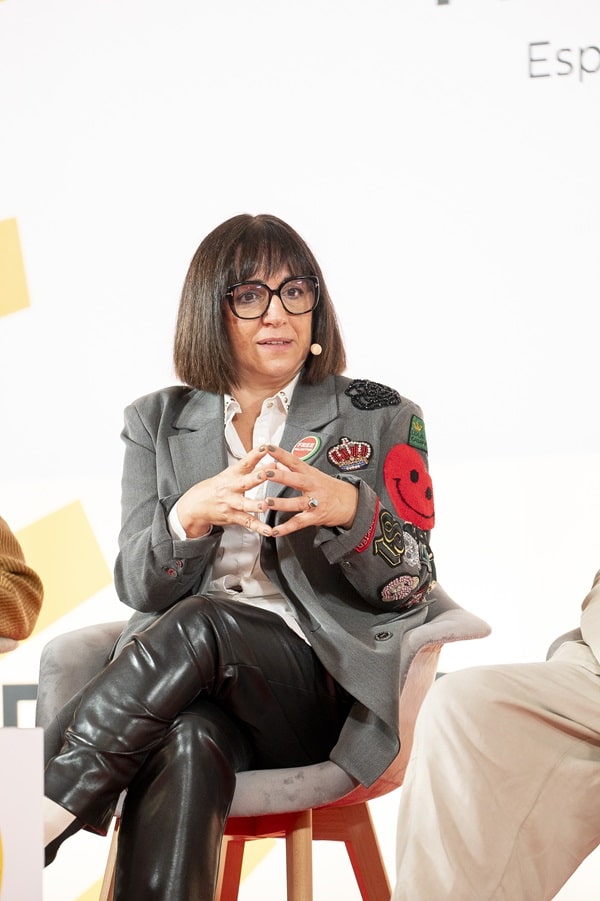
Colell pointed out that one of the biggest challenges was the research: ‘There isn’t much written on the subject, but I did find articles and books that talk about the smugglers. All that material was very interesting; I discovered fascinating stories of people, some even close to the Franco family, who helped people flee from the Nazis.’
She also praised the work of the artistic team in departments such as costume design, art direction, sound design and photography, in order to achieve the ideal setting: “We played with the darkness of that era, both literally and symbolically. In that area, they sometimes had no electricity, and this worked very well to represent fear, that constant state of alertness and threat, of not knowing what was happening in the village itself or who was coming from the other side of the mountain. It was a work with what we see and don’t see, what we hear and don’t hear.”
A small microcosm
Colell has defined this village in the Pyrenees as a small microcosm, which provides an interesting bridge to the attitudes we take towards horror in the contemporary world: ‘There are people who want to denounce and help without hesitation. But there is also a grey area with those people who perhaps initially look the other way, but then realise that they have to help too, even if it means putting their lives in danger.’
The portrayal of this state of alertness was also achieved, in large part, thanks to the acting. Incidentally, Miki Esparbé, who leads the cast alongside María Rodríguez Soto, commented: “The characters live with a latent fear, but they understand that helping is not an option, but rather their nature, their way of understanding life. It’s nice to see the closeness between this couple and understand their gestures of affection, the looks they share, as an extension of their shared need to do good.‘ He added: ’The film is a call to action in times of barbarism and, at the same time, a message of hope. Thanks to people like those in this village, many lives have been saved and continue to be saved.”
This is an idea shared by Asier Etxeandía, whose character in Frontera is one of the most complex: ‘I can’t say much about my character because it would be a spoiler, so I’ll just say that the interesting thing about human beings, the most beautiful thing of all, is that nothing is what it seems. We are all victims of war, no matter which side you’re on.’
A story of yesterday and today
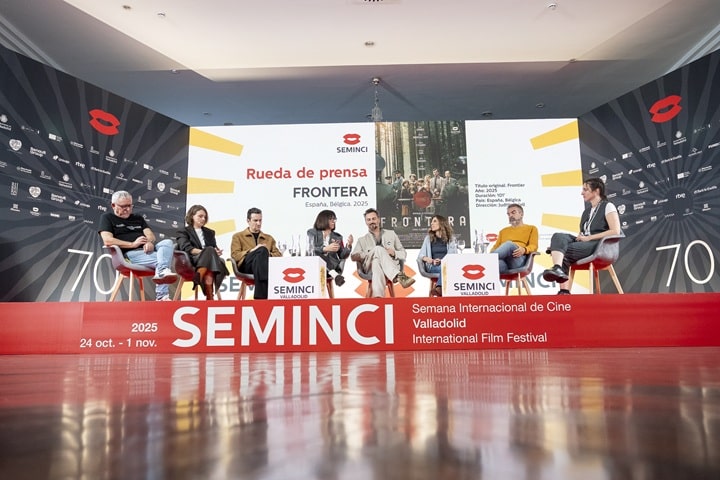
The Frontera team has highlighted the importance of telling these stories from the past in light of the turbulent present we are experiencing as humanity. ‘Reviewing the past and recovering our memory are the only way to understand what is happening. And this is as important now, in the midst of genocide, as it was three years ago with the migration phenomenon,’ said Colell.
The pressing need to remember and tell our story through film has been emphasised by Marta Ramírez (Coming Soon Films), Jordi Frades (Diagonal TV) and Gervasio Iglesias (RTVE). Rodríguez Soto also stated: ‘We build from the wound, from a peace so fragile that it seems like glass, and if you touch it, the horror that still lies dormant spreads. Memory is a political issue, an unresolved matter for the Spanish state and for humanity in general.’