

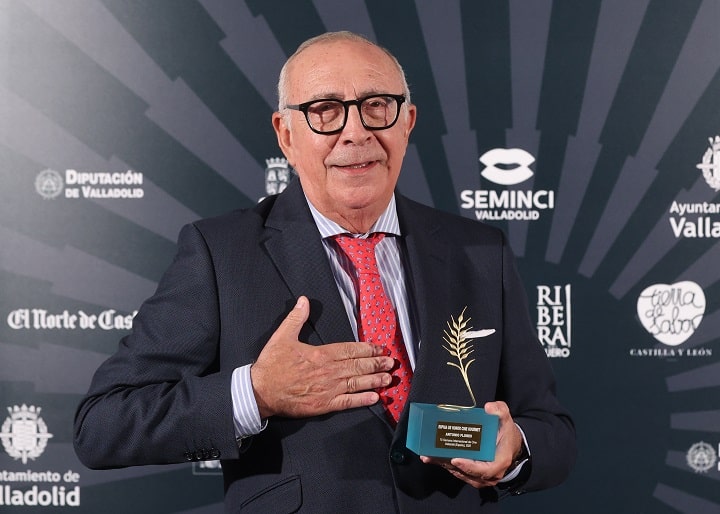
During the Gourmet Film Gala, winemaker Antonio Flores Pedregosa received an Honorary Spike Award
Today, the 70th SEMINCI explored grief and trauma from intimate and deeply human perspectives. On the one hand, Pere Vilà Barceló premiered his film When a River Becomes the Sea in the Official Section, the result of seven years of conversations with victims of gender violence, testimonies that the director considered essential in order to address the issue with respect and consistency. Starring newcomer Claud Hernández alongside Laia Marull and Àlex Brendemühl (awarded Best Actor at Karlovy Vary for this role), it portrays the process of overcoming trauma by a teenage victim of gender violence, where family support also proves to be fundamental in the process. Vilà Barceló rejected any commercial perspective on the length of the film, prioritising making visible all the time spent listening.
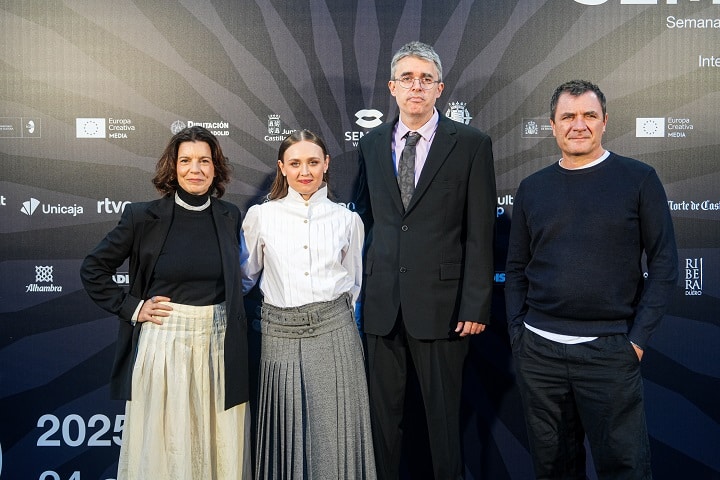
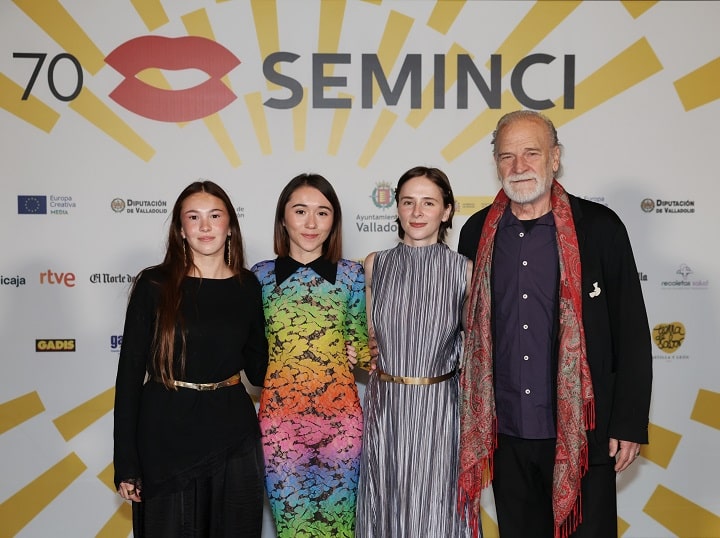
Lucía Aleñar Iglesias presented Forastera at Meeting Point, a unique story about how a teenager copes with the death of her grandmother and how families restructure themselves in the face of loss, highlighting the importance of ‘living through that grief together’. The film, starring Zoe Stein and Lluís Homar, has already received the FIPRESCI award at the Toronto Film Festival and is now being released in Spain. The director explained that she wanted to explore how grief affects the whole family, not just the protagonist, and portrays that complex moment of adolescence where one transitions from childhood to adulthood, using Mallorca from the perspective of an outsider to create an ambiguous and hypnotic atmosphere for the protagonist’s emotional journey.
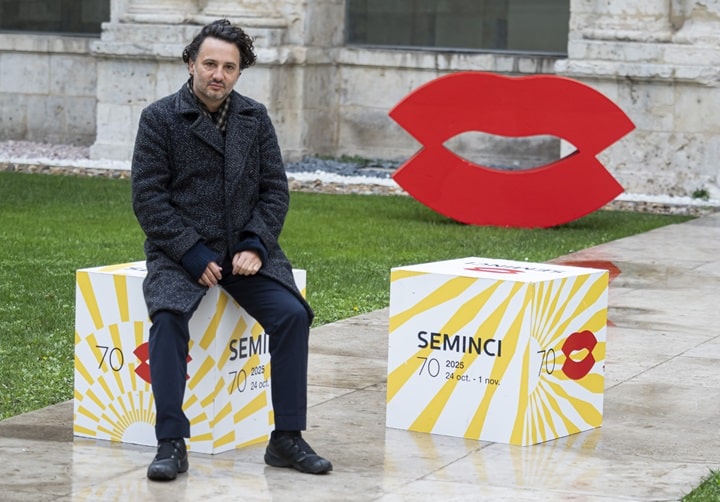
Both films share a focus on shared pain and the essential role of the family as a support network in times of crisis. Crises such as the one faced by the protagonists of The Souffleur, by Argentine director Gastón Solnicki, which premiered in Spain at Meeting Point after its run at the Venice Film Festival. Willem Dafoe plays the manager of a run-down hotel that is about to be demolished. Shot in just two weeks, ‘it’s not a conventional film in its structure, but it allows Willem to float in those spaces in a very memorable and unique way, opening up like vignettes of a world that is disappearing, which is very present not only in this film, which closes my Viennese trilogy, but in all my films, that world that no longer exists,’ according to its director.
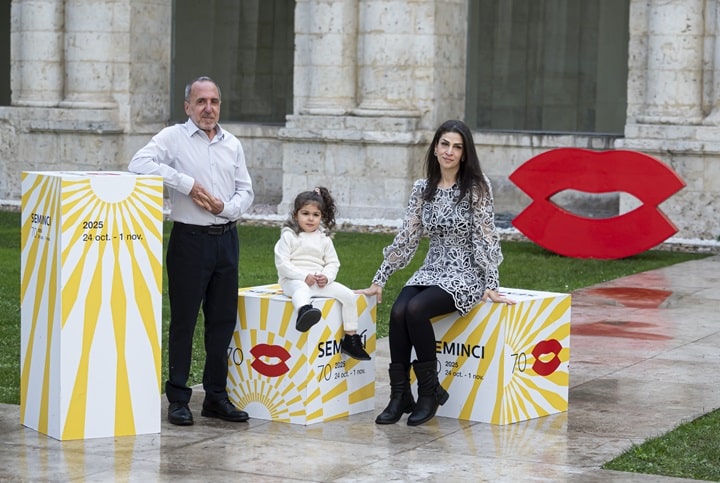
Abbas Fahdel, on the other hand, presents Tales of the Wounded Land, ‘a chronicle of daily life in southern Lebanon during the Israeli bombings.’ The director and his wife and daughter endured constant bombardment for fifteen months. ‘The film is a reconstruction of what we experienced, but not only us, also our neighbours and friends,’ he explained.
Thinking about cinema at SEMINCI
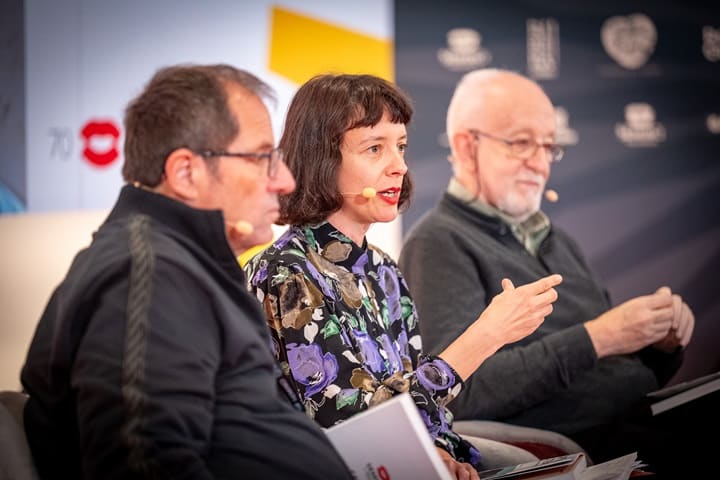
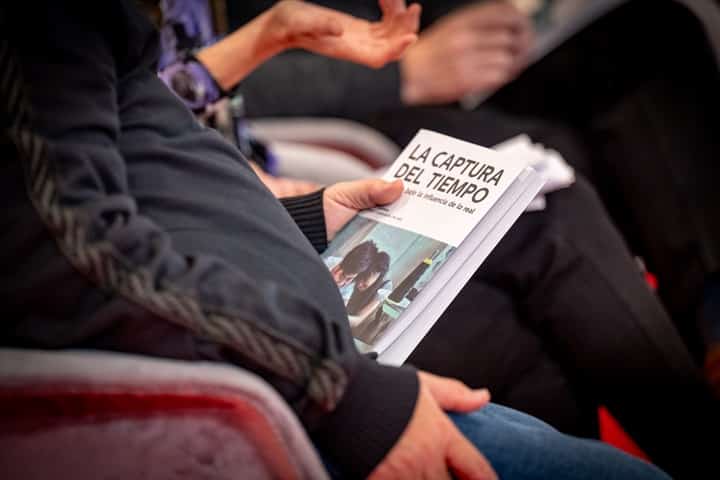
Around the Memory and Utopia cycle and the publication of the book The Capture of Time. A Cinema Under the Influence of the Real, Àngel Quintana, professor of Film History and Theory, Carlos F. Heredero, editorial director of Caimán Cuadernos de Cine magazine, and Laura Gómez Vaquero, PhD in Film History, spoke with Carolina Martínez about the multiple manifestations of cinematic realism.
‘There are many ways of understanding realism, and it was necessary to bring all these ideas together in a book,’ said Quintana. ‘On the one hand, we had to think about how reality could enter cinema; but, in addition, there is a much deeper question: what exactly do we mean by reality? Fellini said at the time that reality is not only what we see, but what we have dreamed, what we have desired, what lies behind the visible,’ he added.
Gourmet Film Gala
In addition to thinking about cinema, it can affect other senses; it can enter through the stomach as well as the eyes. For 14 years, SEMINCI has screened several titles related to gastronomy and wine, very important sectors in this community and throughout Spain. The Gourmet Film Gala held today in Valladolid has paired this sector with cinema on a night in which the oenologist Antonio Flores Pedregosa, Master Blender at the González Byass winery, received an Honorary Spike from the president of the Valladolid Provincial Council, Conrado Íscar, accompanied by the president and general director of the Ribera del Duero Regulatory Council, Enrique Pascual and Miguel Sanz. The award winner acknowledged feeling ‘deeply proud’ and praised the world of wine, where ‘there is fraternity between the two wine regions which are distant in space but united by such an important thing as wine’.
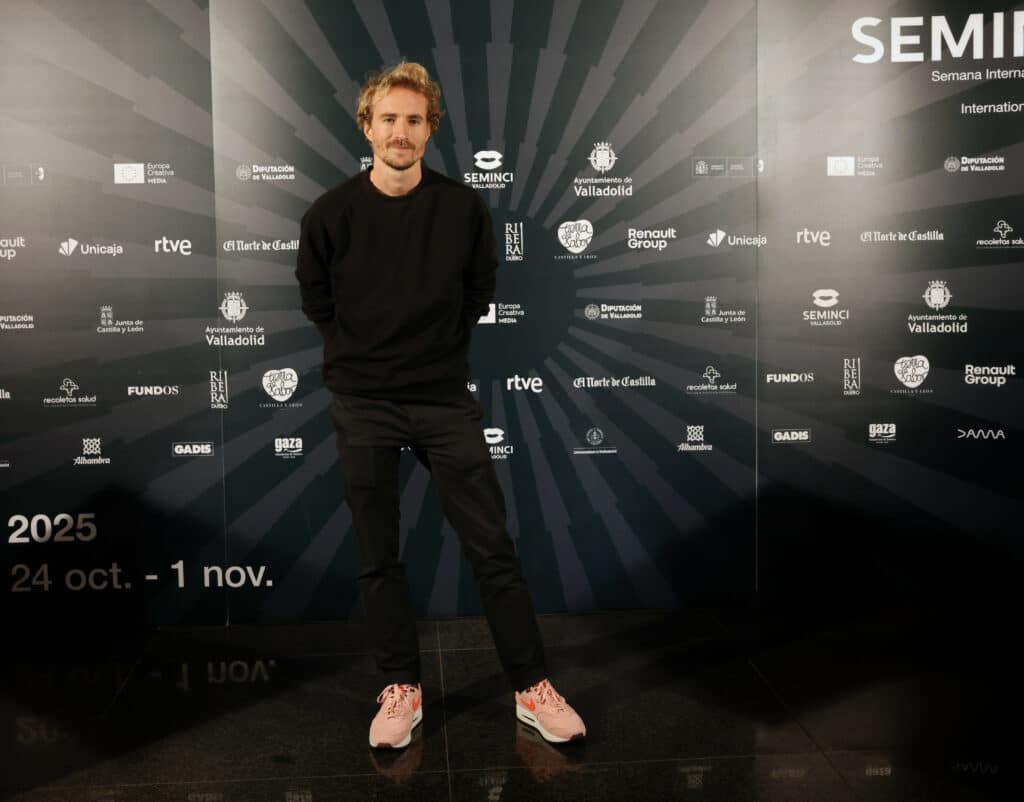
After the award ceremony, the film The Hills of Wrath was screened, a feature-length documentary about the work of winemaker Christine Vernay. Its director, Léo Boudet, described it as ‘a film about poetry’. He added: ‘I feel that poetry has been my way of approaching this film and this family of farmers and winemakers. The passion and dedication these people put into this land is incredible. For me, it was the only way to understand the magic of the countryside and wine.’
Also today, as part of the Castilla y León Gala, actor Luis Callejo received another Honorary Spike Award for his career spanning more than 30 years in film, theatre and television. He was accompanied at the event by director Benito Zambrano and actress Marta Aledo. The Gala was rounded off with the screening of two short films restored by the Castilla y León Film Library: El canal de Castilla (1931), by Leopoldo Alonso, with live musical accompaniment by J. Sasso, and El Noveno, by Basilio Martín Patino.