

SEMINCI launches “Thinking about cinema” with a debate on The Valladolid Controversy and its reflection on screen
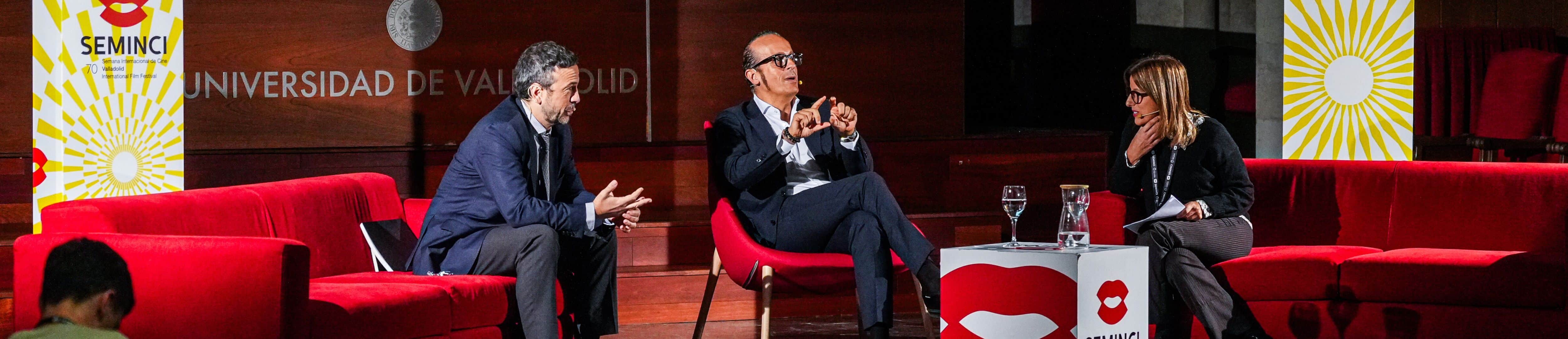
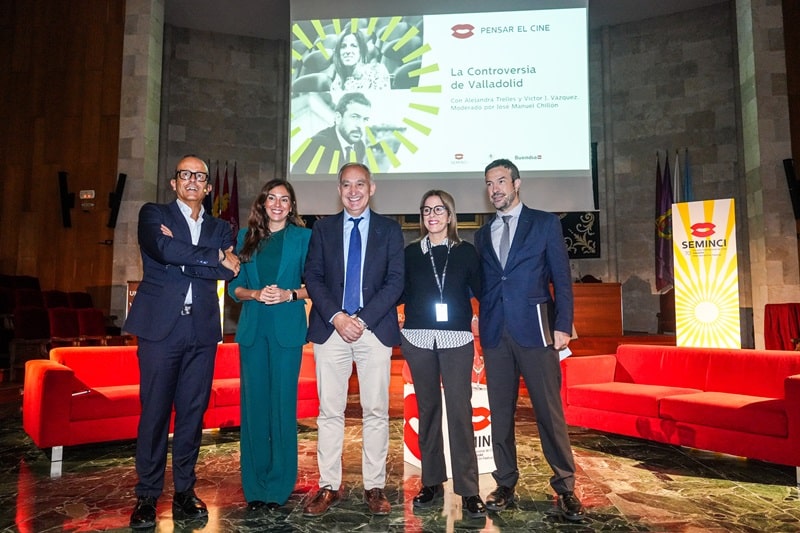
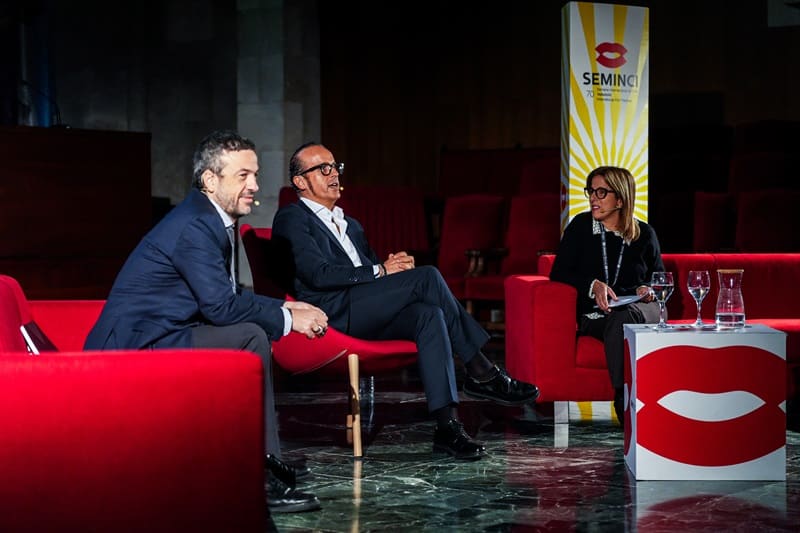
Yesterday, SEMINCI inaugurated the “Thinking about cinema at SEMINCI” meetings, a series of conferences and meetings to explore creative processes and bring the voices of filmmakers and thinkers closer to the festival audience. A transatlantic conversation in the Paraninfo of the University of Valladolid dedicated to the 475th anniversary of The Valladolid Controversy and its relevance in the contemporary debate on human rights kicked off this series of five meetings to reflect on cinema and the world, or the world through cinema. The meeting, which attracted a large audience, featured the participation of Alejandra Trelles, artistic director of the Cinemateca Uruguaya, and historian Víctor J. Vázquez, moderated by philosopher José Manuel Chillón Lorenzo. The programme for the 70th SEMINCI also includes, on the occasion of this anniversary, the screening series “Two shores, an eternal debate. The Valladolid Controversy”.
The historical and legal debate
In 1550, for the first time in history, an empire questioned where its own rights, those of the victor, ended and where the rights of others, those of the vanquished, began. Bartolomé de las Casas and Ginés de Sepúlveda defended two historically antagonistic positions in Valladolid and debated the natural rights of Native Americans. The moderator of this meeting, José Manuel Chillón Lorenzo, defined The Controversy as ‘a philosophical event’, whose repercussions were not temporary but definitive, as it was the first time that humanity and the rights of indigenous peoples were debated.
After his introduction, historian Víctor J. Vázquez addressed the origin and implications of the debate between Casas and Sepúlveda, contextualising the rupture caused by the sermon of Friar Antonio de Montesinos, who in 1511 publicly questioned in Santo Domingo whether indigenous people had souls. This gesture ushered in a crisis of legitimacy that called into question the legal structures of ancient law. Vázquez explained that Francisco de Vitoria was the first to theorise about this rupture, denouncing the inadequacy of medieval law—the Partidas, the Corpus of Justinian, and papal bulls—to answer the essential question: ‘What is an Indian? Does he have legal and moral status?’
The speaker contrasted the two opposing positions: that of Ginés de Sepúlveda, who defended “natural slavery” and the right of conquest in the name of the Empire and evangelisation, and that of Bartolomé de las Casas, who proclaimed the essential equality of all human beings under the formula ‘All races are one man’. Casas defended respect for the autonomy of peoples and the need for peaceful conversion, without violent imposition. Vázquez also highlighted the contributions of Francisco de Vitoria, considered the precursor of modern international law, who formulated concepts such as the right to communication, the right to emigrate, the right to pilgrimage and the right to evangelisation, understood as natural rights that could only be restricted in the event of unjustified resistance.
Lastly, he warned of the risk of committing ‘retrospective injustice’ when judging 16th-century ideas by today’s moral standards, recalling that this controversy gave rise to the thread that would lead to the modern concept of human rights.
Cinematic representation
Director and programmer Alejandra Trelles analysed the evolution of cinematic representation of the conquest of America over more than a century of film, from the heroic vision of the early films to contemporary critical interpretations. Trelles recalled that as early as 1904, in Christopher Colombus, produced by Pathé, the navigator was portrayed as a ‘providential hero,’ a tone that would remain until the interwar period. In Franco’s Spain, Alba de América (1951), by Juan de Orduña, consolidated the image of an imperial and Catholic Columbus. However, from the 1960s onwards, the narrative began to crack: Alberto Lattuada’s miniseries Christopher Columbus (1985) and Ridley Scott’s 1492: Conquest of Paradise (1992) showed an ambiguous hero, victim of his own myth, but without renouncing the epic. The speaker also highlighted the critical European views of Werner Herzog (Aguirre, the Wrath of God), Carlos Saura (El Dorado) and Nicolás Echevarría (Cabeza de Vaca, 1992), who, each in their own way, turned the conquest into an allegory of the moral failure of European empires.
Trelles emphasised that for much of the 20th century, indigenous peoples were represented as masses without a voice or individuality, mere recipients of civilisation. Only with time did more empathetic and complex views begin to emerge, as in Como era gostoso o meu francês (Nelson Pereira dos Santos, 1971), where indigenous people are shown as active subjects with culture and organisation.
According to the programmer, it was not until the 21st century that Western cinema discovered the indigenous perspective. The debate focused particularly on recent Latin American productions, where the conquest is reinterpreted as a theme of the present, not the past. Films such as Zama (Lucrecia Martel, 2017) and Embrace of the Serpent (Ciro Guerra, 2015), both included in the cycle programmed by SEMINCI, abandon the European point of view and approach the encounter between worlds from a transcultural perspective, where indigenous people cease to be objects of history and become its protagonists.
Trelles concluded that colonial heritage continues to be a prevailing structure in Latin American societies: ‘Sepúlveda’s arguments continue to prevail in practice. The inequality and defencelessness of indigenous peoples show that colonial logic persists as a structural problem,’ he said.
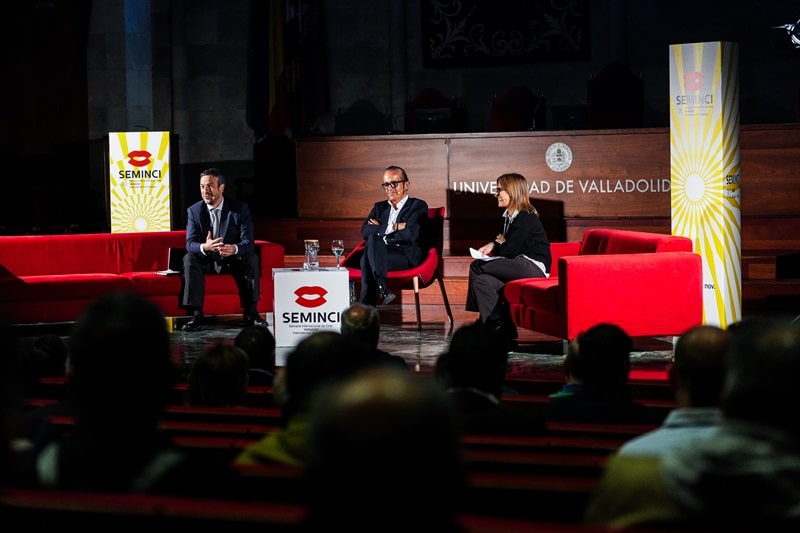
The meeting drew a line between 16th-century legal thinking and contemporary cinematic representations, revealing how the fundamental question of humanity and the rights of indigenous peoples remains open. From Montesinos’ sermon to today’s films, the tension between domination and recognition, between imposition and respect for otherness, persists.
Thinking about cinema at SEMINCI thus establishes itself as a space for reflection and dialogue that invites us to look at the past and the present from the screen, to question the power of cinema as a tool for critical thinking and cultural transformation.