

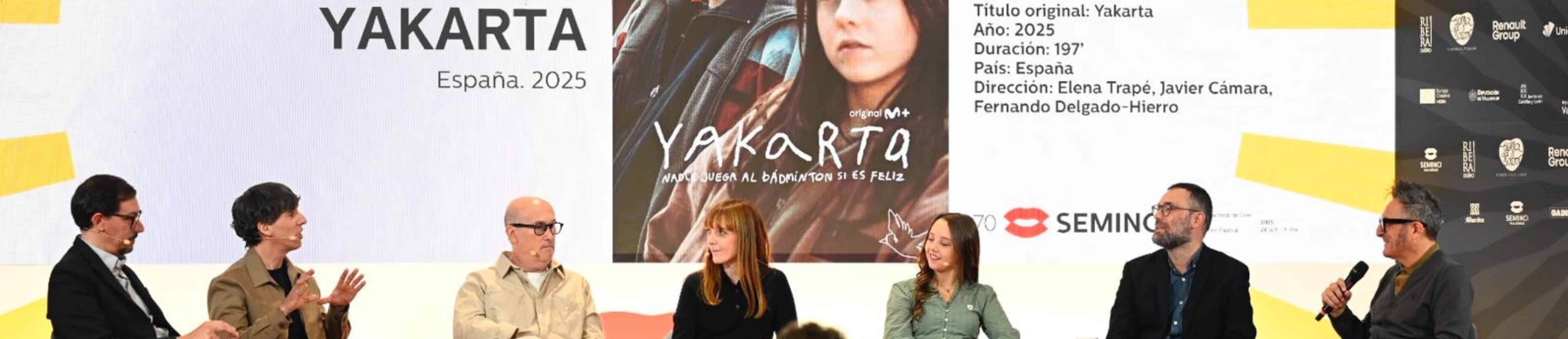
- The 70th edition of SEMINCI hosts the premiere of the original Movistar Plus+ series starring Javier Cámara and Carla Quílez, which will be screened in its entirety during the festival.
Valladolid, 31 October 2025.
The 70th Valladolid International Film Festival (SEMINCI) features, within its Special Screenings section, the world premiere of Yakarta, the new Movistar Plus+ original series created by Diego San José and produced by 100 Balas (THE MEDIAPRO STUDIO) and Buendía Estudios Canarias. The inclusion of Yakarta in this year’s programme reinforces the festival’s commitment to auteur television, having previously hosted premieres of major works such as David Lynch’s Twin Peaks and Lars von Trier’s The Kingdom.
The filmmaker reunites with Javier Cámara, winner of two Goya Awards for Best Actor, following the success of Vota a Juan (2019), in a six-part production that tells the story of Joserra, a PE teacher and former badminton player who meets Mar (played by Carla Quílez), a teenager with remarkable talent for the sport. ‘The idea came from wanting to talk about people who would never be heroes in any story. The series is a monument to losers. I think victory is far more tempting from a narrative point of view, and I wanted to avoid that,’ said San José.
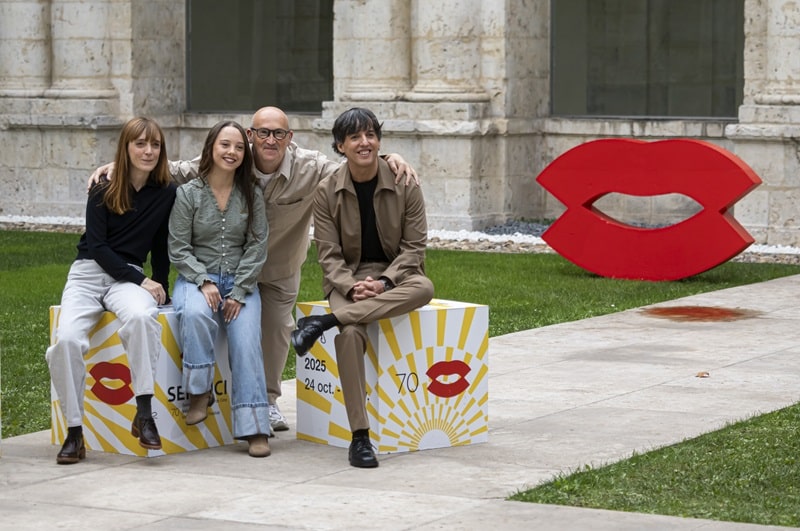
In this sense, the creator spoke of his intention to move away from comedy in this project, venturing into darker territory and exploring more sordid characters: ‘When I used to write comedy, I realised that the moments I enjoyed most were those without jokes —when emotions emerged. I wanted to stop paying the debt of the punchline and keep Yakarta in a grey, sad place,’ he confessed.
Elena Trapé, who previously worked with San José on Celeste (2024) and directs several episodes of the series, spoke about the need to build the story through subtlety: ‘We were concerned about being able to convey the pain the characters feel through the camera and the atmosphere. But we didn’t want to go for something showy —we had to tone it down and hold back, because that hurts much more,’ she explained.
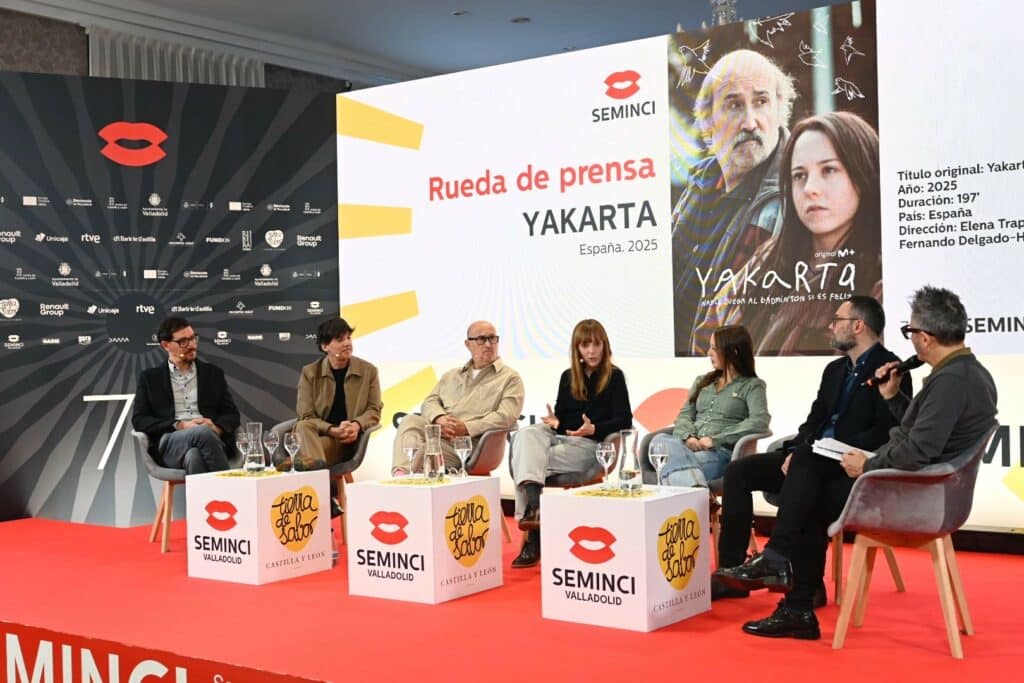
Javier Cámara, who also directs one of the episodes, reflected on one of the guiding principles of the series, the deliberate removal of humour from the characters’ lines: ‘That nakedness Diego wanted scared me, because it stripped me of so many things; there was almost nothing to hang to narratively,’ he noted.
The relationship between characters and setting
The team, joined in Valladolid by Fran Araujo (executive producer, Movistar+) and Alejandro Flórez (executive producer, 100 Balas/The Mediapro Studio) spoke about the writing process behind such complex characters, designed to blend seamlessly with the visual identity and immersive atmosphere of the series.
Javier Cámara explained that he needed a great deal of freedom from the directors to shape the peculiar character of Joserra: ‘I was in the best hands, with two friends; I had two safety nets who supported me in facing this man full of rage and revenge,’ the actor shared. ‘At my age, everything needs to be raw and exposed. I’ve judged myself enough already; if someone wants me for a project now, I have to give myself to it completely.’
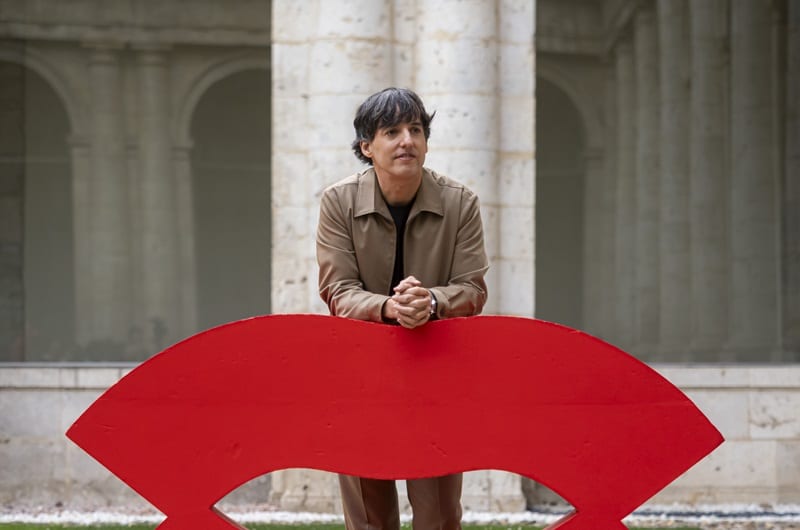
Carla Quílez (Concha de Plata a mejor actriz en el Festival de San Sebastián) ha recordado que tuvo que jugar al bádminton con un entrenador profesional para conseguir el papel. Sobre su personaje, cree que «no vas a quererla de primeras. Ese arco emocional de los personajes hace que los entiendas poco a poco, pero son muy oscuros. No saben que lo que necesitan lo tienen al lado».
La serie narra el difícil viaje por polideportivos desconchados y hostales de mala muerte de ciudades de provincia, unos espacios que no han sido habitualmente filmados en el audiovisual español, algo sobre lo que el equipo ha incidido especialmente. Diego San José ha reconocido la influencia de El viaje a ninguna parte, de Fernando Fernán Gómez, en la idea de recorrer una España agresivamente real y nada bucólica. «Para mí Ponferrada es Dallas. Nuestro Midwest no está contado, y hay algo muy importante de contar esa España que no es habitual en la ficción», ha declarado. «No es una mirada costumbrista ni naturalista, buscábamos convertirla en un lugar que nos ayudase a contar lo que les estaba pasando a los personajes», ha concluido Elena Trapé.
Carla Quílez —winner of the Silver Shell for Best Actress at the San Sebastián Film Festival— recalled having to train with a professional badminton coach to earn the role. Regarding her character, she said: ‘You won’t like her straight away. The emotional arc of these characters makes you understand them little by little, but they’re very dark. They don’t realise that what they need is right beside them.’
The series follows a tough journey through dilapidated sports halls and seedy provincial hostels, spaces rarely depicted in Spanish audiovisual fiction, something the team was particularly intent on exploring. Diego San José acknowledged the influence of Fernando Fernán Gómez’s El viaje a ninguna parte (Voyage to Nowhere) in his decision to portray an aggressively real, unsentimental Spain: ‘For me, Ponferrada is Dallas. Our own Midwest hasn’t been told, and it’s important to give voice to that Spain that’s not usually represented in fiction,’ he said. ‘It’s not a naturalistic perspective, we wanted to turn it into a space that helps us tell what’s happening inside the characters,’ concluded Elena Trapé.