


- The actor received the award at the Castilla y León Gala, where the short films restored by the Castilla y León Film Library, “El canal de Castilla” and “El noveno”, were screened.
The 70th Valladolid International Film Festival has awarded the Honorary Spike to Segovian actor Luis Callejo at the Castilla y León Film Gala. With almost 30 years of experience as a performer, Callejo has participated in more than a hundred plays, short films, feature films and series, receiving three Goya Award nominations: Best New Actor in 2006 for Princesas, by Fernando León de Aranoa; Best Male Lead in 2017 for The Fury of a Patient Man by Raúl Arévalo, and Best Supporting Actor in 2020 for Out in the Open by Benito Zambrano, the film that opened the 64th SEMINCI.
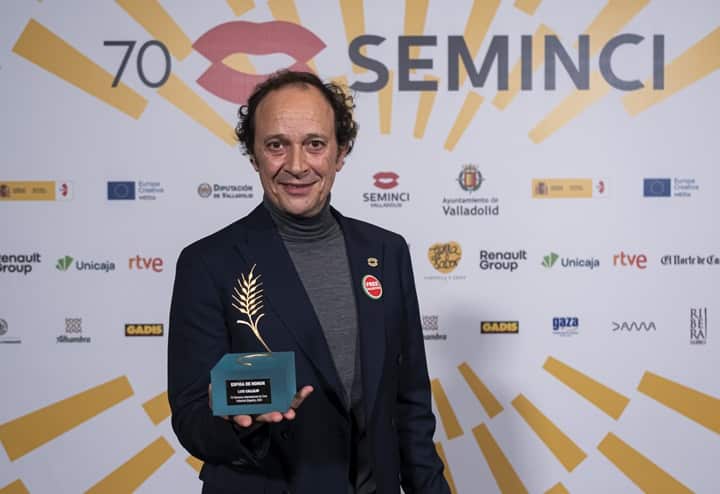
It was Zambrano himself, together with actress and screenwriter Marta Aledo, who dedicated a few words to Callejo before the Regional Minister of Culture, Tourism and Sport of the Junta de Castilla y León, Gonzalo Santonja, presented the award. ‘It is the most beautiful and important award I have ever received in my life. I take it as a responsibility and an encouragement to move forward,“ said the actor, who expressed his support for the victims of the DANA and the Palestinian cause. Luis Callejo dedicated the Honorary Spike to all his teachers and colleagues at RESAD: ‘I love my profession because is a profession based on learning. Encourage your children to become actors and actresses; they will meet people and see the world,’ he concluded.
A martial art
‘I never thought about becoming an actor until the opportunity arose and I felt very comfortable,’ said Callejo, whose first contact with the performing arts was in a workshop while studying law in Paris on an Erasmus exchange programme. Upon returning to Spain, he graduated from the Royal School of Dramatic Art in Madrid (RESAD) and began his career starring in short films by Sergio Barrejon and Jose Manuel Carrasco, among others. It wasn’t long before he made the leap to cinema with films such as The Longest Penalty Shot in the World and El club de los suicidas (The Suicide Club), both directed by Roberto Santiago.
Since then, he has appeared in more than thirty feature films, including titles such as The Mule (Michael Radford, 2013), People in Places (Juan Cavestany, 2013), Wounded (Fernando Franco, 2013), Palm Trees in the Snow (Fernando González Molina, 2015), Kiki, Love to Love (Paco León, 2016), The Man with a Thousand Faces (Alberto Rodríguez, 2016), Tarde para la ira (Raúl Arévalo, 2016) and Oro (Agustín Díaz Yanes, 2017). He has also appeared in television series such as Rodrigo Sorogoyen’s Apagón, Vestidas de azul, Asuntos internos, The Snow Girl 2 and Berlín II.
His latest film work includes La casa by Alex Montoya, The Captive by Alejandro Amenábar, and Sin cobertura by Mar Olid. In addition, Sacamantecas by David P. Sañudo and La luz by Fernando Franco are awaiting release. In 2026, he will also premiere the production La escopeta nacional (The National Shotgun) under the direction of Juan Echanove for the Teatro Español. ‘Acting is a martial art. You have to remain calm during the storm; it requires a lot of mental control. It’s a truly peculiar profession, and I want to do this until I die, until I’m very old and they call me to play a dying man,’ said Callejo with a laugh.
Castile and León Film Gala
For the ninth year, SEMINCI celebrates audiovisual production in Castile and León with this gala, presented by actor Borja Maestre at the Zorrilla Theatre, to celebrate the career of one of the most renowned and valued actors in Spanish cinema. The gala seeks to be a showcase for local talent, which last year alone hosted 339 film shoots, an increase of 28% from the previous year. Another of the pillars of the Community is the restoration work carried out by the Castilla y León Film Library, which the mayor of Valladolid, Jesús Julio Carnero, has defined as ‘the umbilical cord with the Junta de Castilla y León’. Thanks to these efforts, the Valladolid audience has been able to enjoy two essential short films from the film heritage.

The first of these was El canal de Castilla (1931), by the Salamanca pioneer Leopoldo Alonso, screened with live musical accompaniment by J. Sasso, creating a sound and visual dialogue through the ages from experimentation. This was followed by El Noveno, the third short film by the acclaimed Basilio Martín Patino. This film featured some of the biggest names in the history of Spanish cinema, such as Mario Camus, Luis Enciso and José Luis Borau, but remained lost for decades until it was recovered by the film library of Castile and León.