

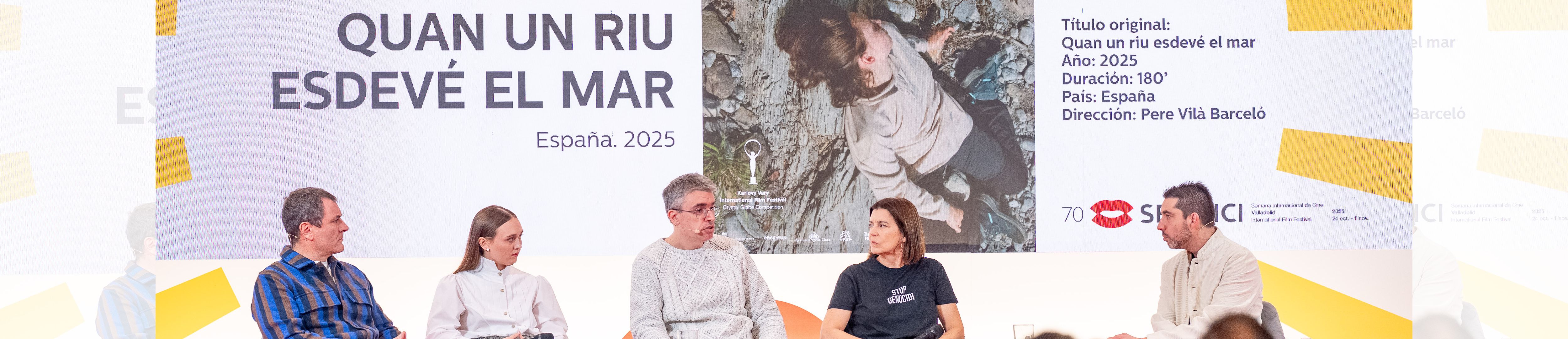
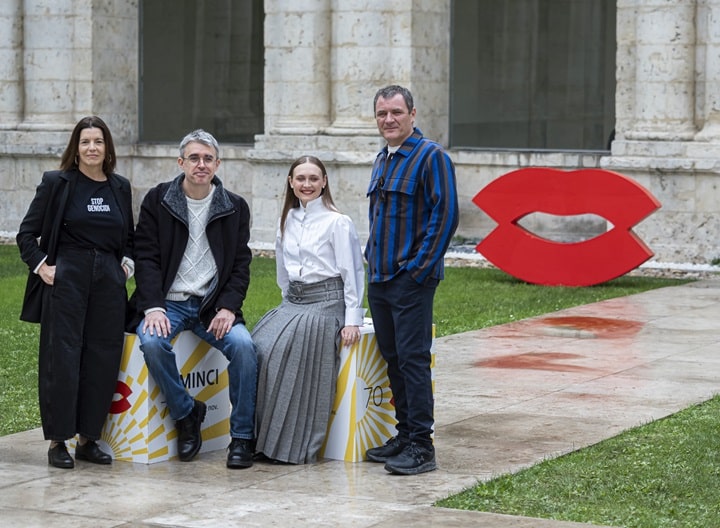
- The filmmaker presented the film at the 70th edition of SEMINCI, accompanied by actors Claud Hernández, Laia Marull and Àlex Brendemühl.
Director Pere Vilà Barceló premieres his sixth feature film, When a River Becomes a Sea, today in the Official Section of the 70th edition of the Valladolid International Film Festival (SEMINCI). The Catalan director returns to Valladolid for the third time after presenting his previous works, Lapidation of Saint Etienne (2012) and The Invisible Artery (2015), at the festival.
The delicate portrait he paints of a teenager overcoming trauma, unable to fully understand what has happened to her, stems from years of conversations with victims of gender violence, which are reflected in the experiences of the main character: ‘It would have been impossible to do it without them, out of respect and consistency. I can’t imagine just writing a script and making things up from news stories,’ said the director, defending the importance of human contact and the gift that has been the time shared with these women.
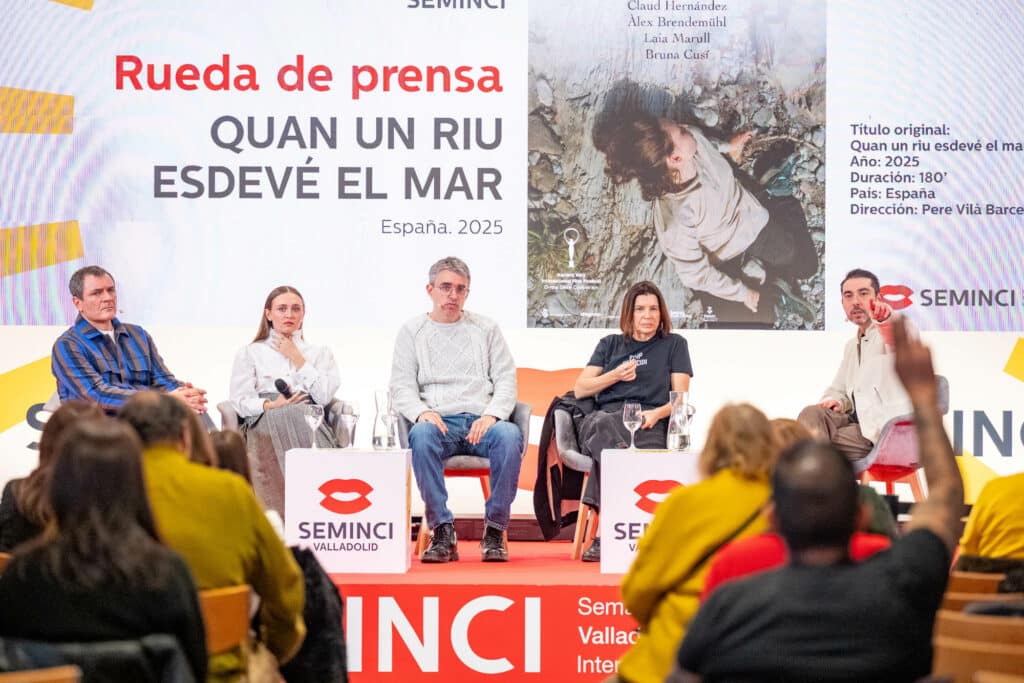
On the other hand, regarding the length of the film, the filmmaker reflected on the need to make visible in the final result all the time he spent listening to the victims’ testimonies: ‘I didn’t care about the length; we often put time on the back burner. That’s why I can’t think about what happens in this film from a commercial point of view.’
Claud Hernández, who makes her feature film debut with this film, has admitted that her experience playing Gaia has completely changed her: ‘I have spoken to many women who have experienced abuse. Many times I was afraid of not being up to the task, and I had to try to create a kind of reservoir within myself to retain their testimonies and reflect them on screen,’ said the actress. ‘Pere gave me a camera and told me to send him improvisations, and from there, we built the character,’ added the actress.
Àlex Brendemühl, who won the Best Actor award at the Karlovy Vary Film Festival for his work in this film, emphasised the director’s unique approach to scenes and rehearsals, in which he let the actors’ intuition guide the sequences: ‘This is the third film I’ve made with him, and I have complete confidence in the research he did. With four words, he puts you in the situation; he introduces you to that universe, he lets you explore that pain, the moments of silence. The camera always favours the performance,’ said the actor.
The importance of support
Brendemühl plays the teenager’s father, a fundamental supporting figure for the young girl in the film. ‘I thought it would be interesting to avoid the figure of the problem-solving father; I wanted to find a profile of someone who is simply by her side and dismantle this idea that the father has to do something. He’s just there, and that’s what’s important,’ said the director. The actor added: ‘We felt that this gave the character much more humanity and freed him from expectations about his behaviour.’
Filming method
Improvisation with the actors was one of the fundamental aspects of the shoot, for which there was no shooting schedule. Laia Marull, winner of three Goya awards, explained that, in her opinion, Vilà Barceló continues to explore while filming: ‘One day he suddenly appeared with lots of new pages of script for the scene, but without imposing them on us, so we felt that we were in control of the timing.’
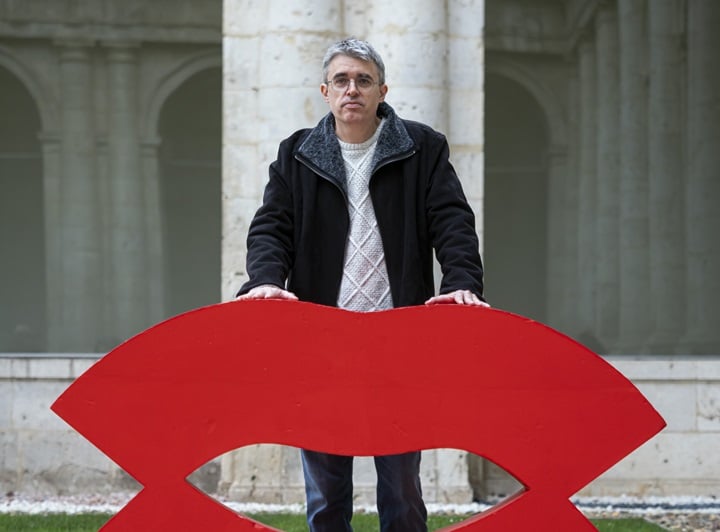
The question of time is, for the director, fundamental to the film, which is reflected in the way it is shot with the aim of allowing emotions to emerge and scenes to breathe: ‘Emotions cannot be fictionalised. It’s true that they are actors, but I like it when, in addition to the character, the person is also there. I adapt to the space they need, so the shot has to be based on their movements and decisions.’