

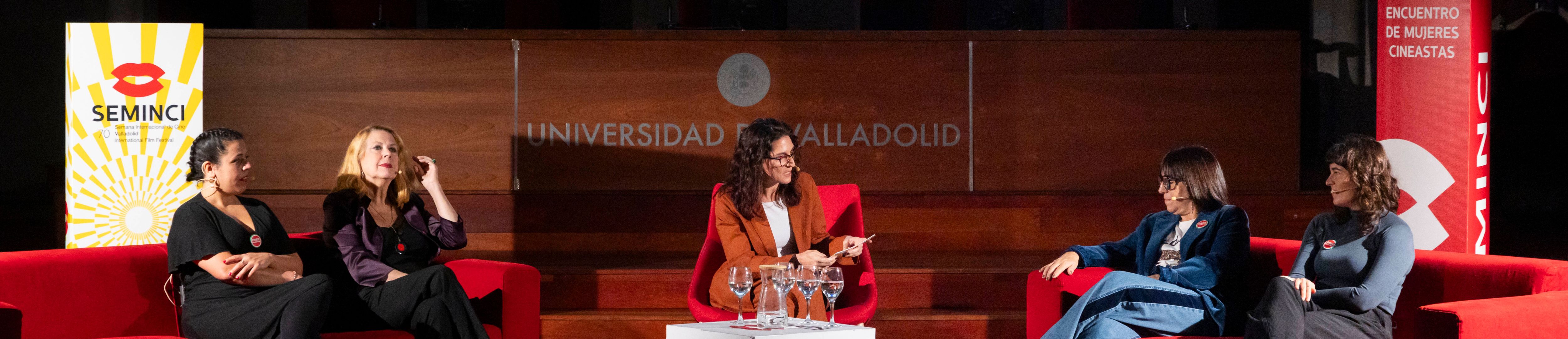
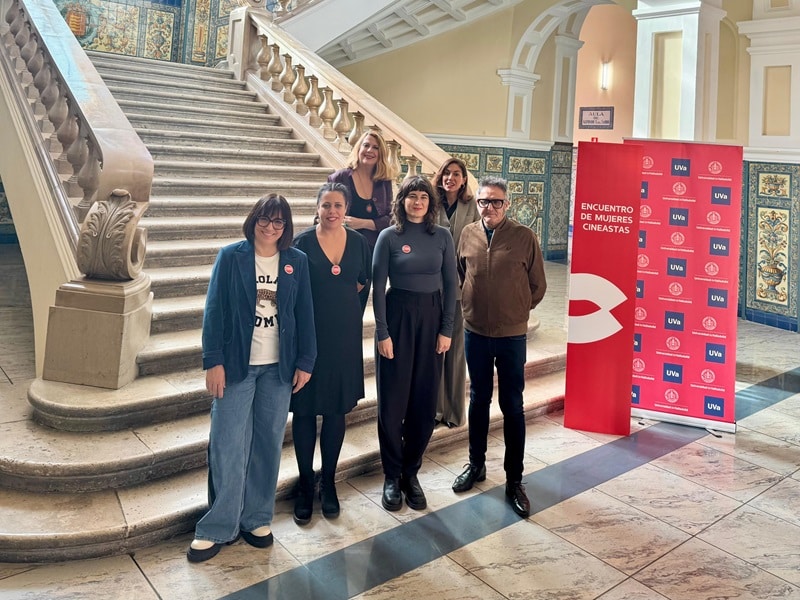
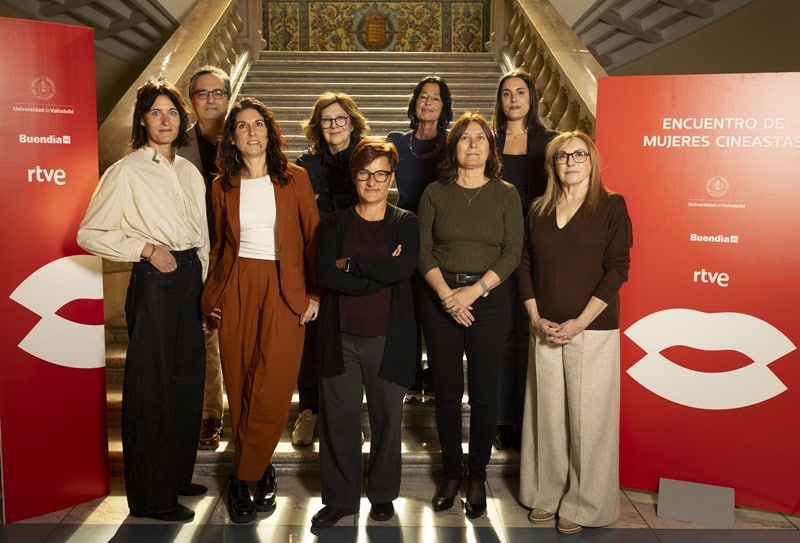
- Directors Judith Colell, Candela Sotos, Amparo Climent and Inés Aparicio presented their militant cinema projects.
- Laura Feyto, Head of the Accessibility Unit at TVE; Beatriz Aparicio, Head of RTVE’s Equality Observatory; and music supervision specialist Judith A. Riera discussed the emergence of new professions within the audiovisual sector.
- Creative duos Mar Coll and Valentina Viso, and Paula Ortiz and María Zamora shared insights into their collaborative working methods.
Valladolid, 1 November 2025. The Valladolid International Film Festival (SEMINCI) hosted the second Women Filmmakers’ Gathering on 28 October, held at the Paraninfo Hall of the University of Valladolid. The event, curated and moderated by cultural journalist Begoña Donat, explored the themes of activism, collaboration, and the future of cinema made by women. Conceived as a forum for dialogue, the meeting placed the transformative power of the audiovisual medium at its core, focusing on how women creators have helped, and continue to help, reimagine memory and open new professional, artistic and collective pathways.
The Gathering opened with a round table titled “Militant Cinema”, featuring directors Judith Colell, Candela Sotos, Amparo Climent, and Inés Aparicio. The discussion focused on cinema as a tool for historical memory and social commitment, as well as the challenges faced in an era of disinformation and political polarisation.
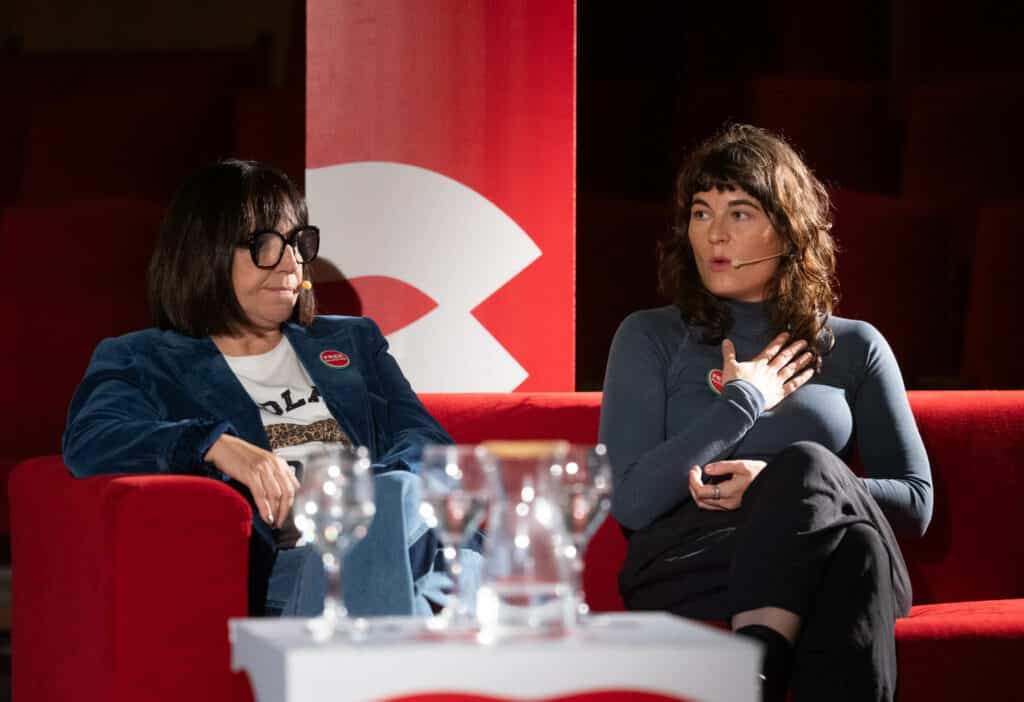
Director Judith Colell sought to provoke reflection, and, to some extent, discomfort and a call to action, with her latest film, Frontera, premiered out of competition in the Official Section of the 70th SEMINCI. As she explained, the feature stemmed from a proposal by producer Marta Ramírez, who shared with her a screenplay by Miguel Ibáñez Monroy and Gerard Giménez, ‘a text that spoke to the present’, addressing current migratory processes and the social scars left by the Civil War. ‘In the film, when the refugees arrive, some people help, others denounce them, and most simply look away. The film is dedicated to those who help, and above all, to those who look away, as we so often do,’ she said.
For Candela Sotos, director of Yrupê, screened in the Time of History section at this year’s SEMINCI, the seed of her project lay in discovering that her great-uncle Guillermo Fernández-Zúñiga had gone into exile after taking part in the Pedagogical Missions during the Second Republic. ‘When I finally gained access to the archives, it was the first time I saw Spaniards in concentration camps on film. Memory is essential, and I see this project as an exercise of responsibility towards a shared historical memory that represents us all,’ she reflected.
Filmmaker Amparo Climent’s career has long been defined by her commitment to historical memory and the defence of women’s rights. Her latest work, Pasionaria, revisits the life of Dolores Ibárruri, aiming to bring her legacy to younger generations and to give voice to a twentieth-century icon. ‘Each of us must do our part to recover the historical memory of those close to us. For me, this is a way of achieving poetic justice, through cinema and through democratic memory,’ she stated.
From a more experimental angle, Inés Aparicio presented her animated short La diva, mi abuela y yo, competing at SEMINCI. Inspired by her grandmother’s musical legacy, the project features the artistic collaboration of Rodrigo Cuevas. ‘This short film, devoted to both family and collective memory, recovers the figure of cuplé singer Lilian de Celis. Through popular culture and folklore, one can engage deeply in activism,’ she said.
Emerging Audiovisual Professions: New Pathways Towards Equality
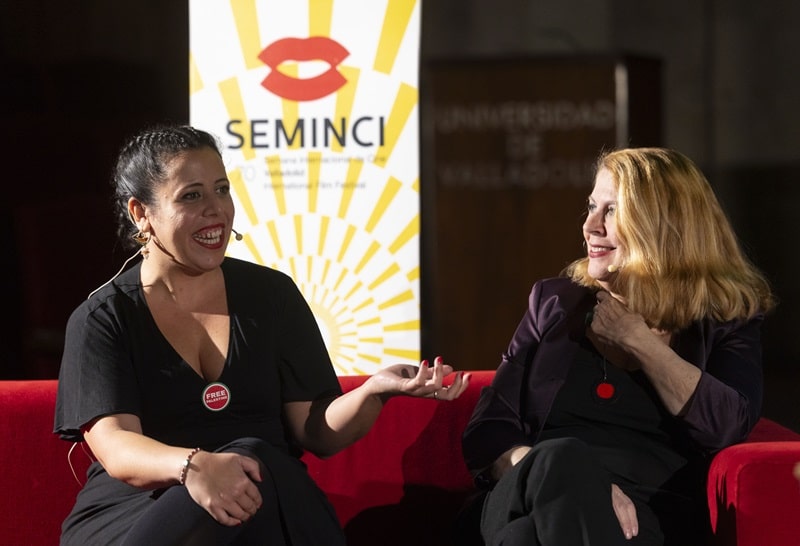
Under the premise that emerging professions in the audiovisual industry represent ‘fertile ground’ for gender equality, the Gathering continued with a round table organised by RTVE’s Equality Observatory, in collaboration with CIMA. ‘There are a series of professions that are fertile ground for women, because they are not yet dominated by either gender — they are still open terrain we can build from a place of equality,’ explained Mercedes de Pablos, president of the Observatory.
Participants included Laura Feyto, Head of the Accessibility Unit at TVE; Beatriz Aparicio, Head of the Equality Observatory at RTVE; and Judith A. Riera, a specialist in music supervision.
Feyto introduced the emerging field of accessibility specialists, ‘a profession that, by law, must now be present in all audiovisual media, and which is therefore set to grow considerably,’ she noted. She outlined the three methods currently used by RTVE to make content accessible to people with disabilities: subtitling, audio description, and sign language interpretation. Future plans include introducing cognitive accessibility measures, such as simplified newscasts available via RTVE’s website.
She also shared figures showing 81,000 hours of subtitled programming across TVE’s nine channels and 8,800 hours of annual audio description, describing the latter as ‘an art not yet fully recognised or taught at university level.’ Additionally, TVE has implemented personalised sign language interpretation through HbbTV technology. ‘We have no limits, new ideas keep coming. It’s a profession in its infancy, and there’s so much more ahead,’ Feyto concluded.
Beatriz Aparicio, Head of RTVE’s Equality Observatory, explained that their work ‘permeates the entire organisation in a transversal way.’ Founded in 2017, the Observatory has two main responsibilities: ‘to ensure compliance with legal commitments on equality and to monitor content to guarantee it promotes gender equality.’ In 2023, the Observatory launched training programmes on identifying gender bias on screen and incorporating feminist perspectives, ‘which were very well received.’ The State Pact Against Gender Violence, renewed in February 2025, has also introduced new criteria on gender equality and the prevention of gender-based violence into the selection processes for film projects.
Speaking on the power of the image, Aparicio was emphatic: ‘Audiovisual imagery is extraordinarily powerful. We must think carefully about what is shown, how it is shown, and what remains unseen. Stereotypes are not just descriptive, they are prescriptive. Images create realities; they serve as visual maps that shape how we learn.’ She cited as examples films created with a gender-conscious approach such as Rita by Paz Vega, Lullaby (Cinco lobitos) by Alauda Ruiz de Azúa, La maternal by Pilar Palomero, and Take My Eyes (Te doy mis ojos) by Icíar Bollaín.
Judith A. Riera, who worked as music supervisor on Pablo Berger’s Robot Dreams, thanked SEMINCI for giving visibility to new film professions through the Women Filmmakers’ Gathering. ‘Naming these roles gives visibility to our work, and, more importantly, value,’ she said. Her role, she explained, involves ‘making possible the soundtrack the creative team envisions for their film or series, within the available budget. Far from limiting creativity, it often enhances it.’
Her work begins at the script stage, deciding which scenes will use original or licensed music, followed by rights management ‘a detective adventure,’ as she described it. ‘I love the challenge of finding and negotiating rights. There’s always a positive side,’ she added.
Reflecting on industry changes, Riera observed: ‘Negotiations over music rights used to be more masculine and aggressive. Now that more women are involved, our approach is different, more honest and transparent.’ She concluded: ‘In nearly every project I work on, it’s women who bring me on board. We’re opening spaces for one another, and that mutual support is vital.’
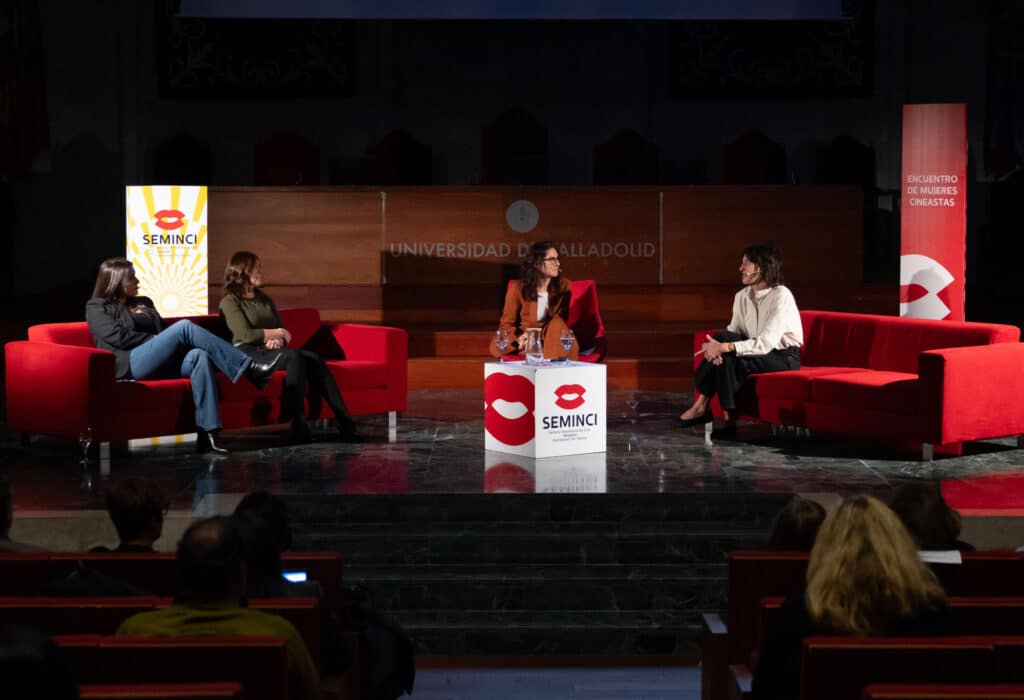
Creative Partnerships
The Gathering concluded with a panel titled “Creative Partnerships”, exploring how filmmaking has evolved in recent years towards more horizontal, collaborative models.
The session featured two creative pairs: director Mar Coll (Goya Award for Best New Director for Three Days with the Family) and screenwriter Valentina Viso (who has collaborated with filmmakers such as Carla Simón and Borja Cobeaga); and filmmaker Paula Ortiz (winner of SEMINCI’s Pilar Miró Award for Chrysalis in 2011) alongside producer María Zamora, whose credits include The Days to Come and Alcarràs, and founder of Elástica Films.
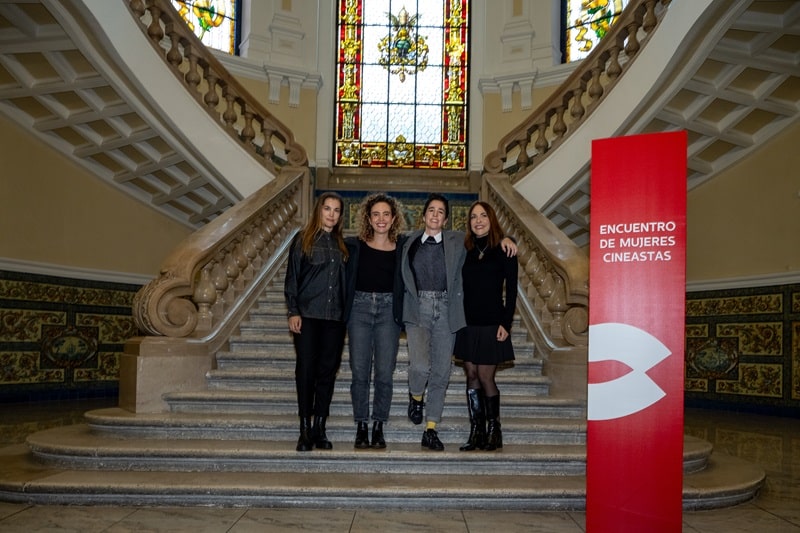
Valentina Viso opened the debate by reflecting on the difference between traditional authorship and collective creation, emphasising the value of collaboration: ‘We always start on equal footing. There’s no screenwriter who doesn’t want to hear from the director, or vice versa. In my experience, equality comes from working with people you trust.’ Mar Coll added: ‘We’re both on the same creative level during pre-production. Unfortunately, in many projects, writers are sidelined once development begins.’
Paula Ortiz reflected on a wider artistic shift: ‘We’re moving away from the tyranny of the creator, whether director, producer or actor. We waste less energy now, and if you have the patience to listen, two minds really do think better than one. Our communication is very direct, María always says what she thinks, and that honesty is invaluable.’
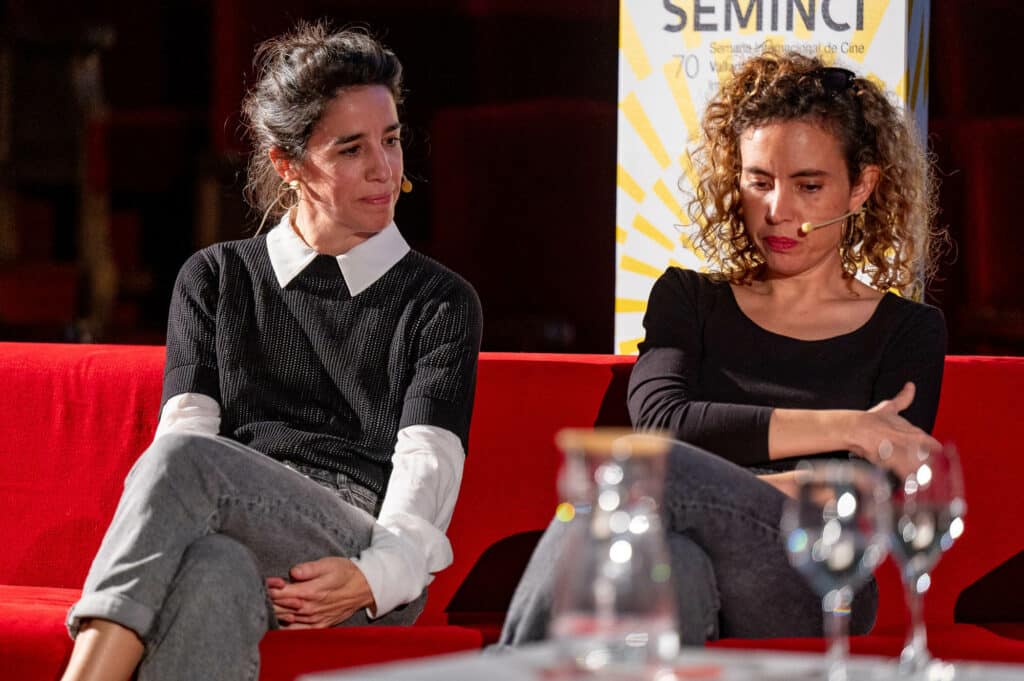
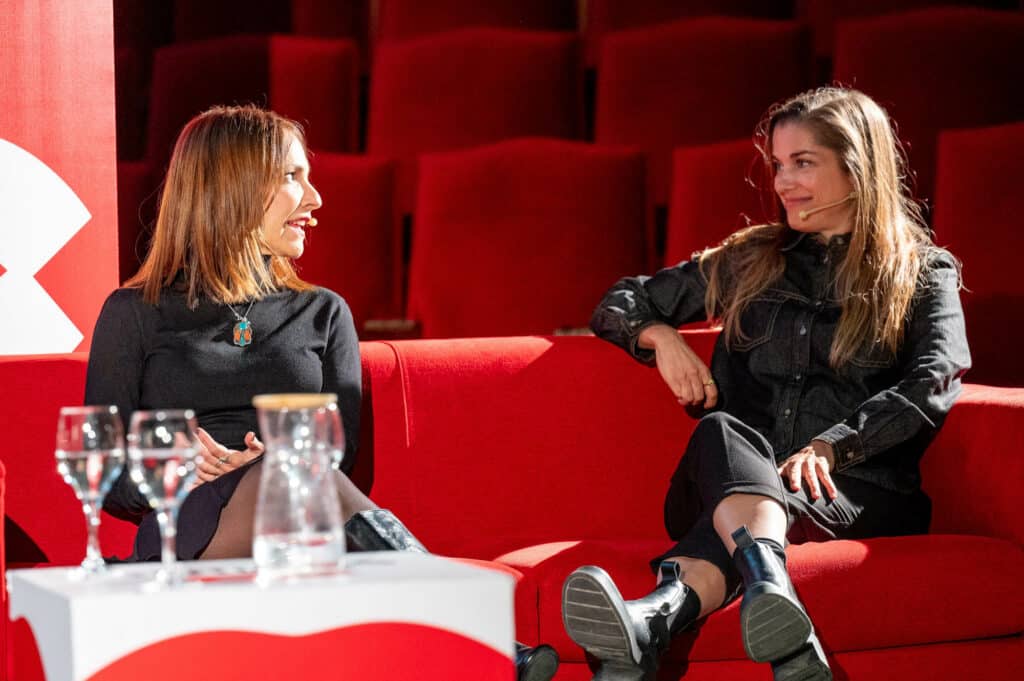
When discussing how media promotion often centres attention on directors and actors, the speakers underscored the collective nature of filmmaking. ‘There’s a clear gap between the story told in film promotion and the reality behind the scenes,’ noted Coll. Since receiving the 2024 National Film Award, María Zamora has become a visible advocate for producers’ creative roles, yet she defended the importance of respecting directorial authorship: ‘Even though I’m behind the camera, it’s a Paula Ortiz film, and that’s how it should be. Many producers of my generation think collectively, always with collaboration in mind.’ Ortiz, in turn, highlighted producers as drivers of cinematic currents, broadening the idea of authorship, to which Coll added: ‘Spanish cinema is in the hands of producers. They decide which films get made, even if they aren’t ultimately their authors, and that’s worth remembering.’
On women’s contribution to changing work dynamics, Zamora observed: ‘I’ve noticed more beneficial dynamics on sets where there’s a way of working we might call feminine.’ Ortiz concluded: ‘Beyond gender, these changes are also generational. They bring new sensitivities. Thankfully, things have evolved, though everything remains fragile.’