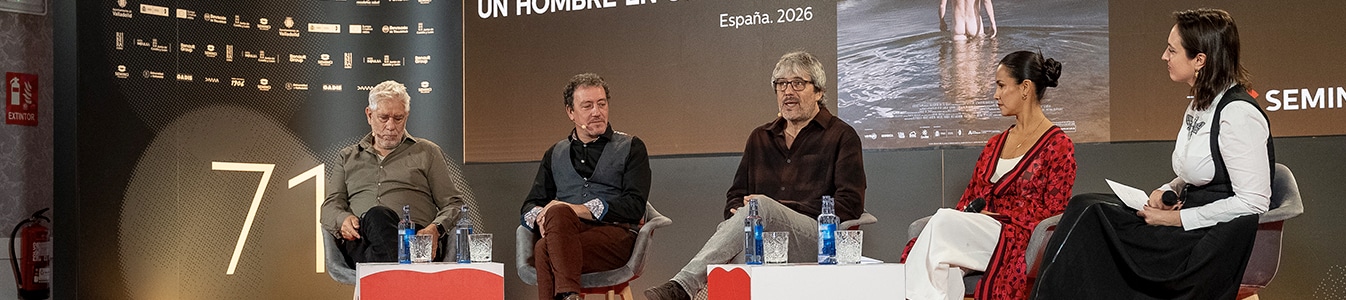
- Martín de los Santos’s second feature film has its world premiere in the Official Section of the 71st SEMINCI.
- Starring Roger Casamajor and Belén Cuesta, the film tells a story of second chances, following a difficult character who returns to his hometown to rebuild his life.
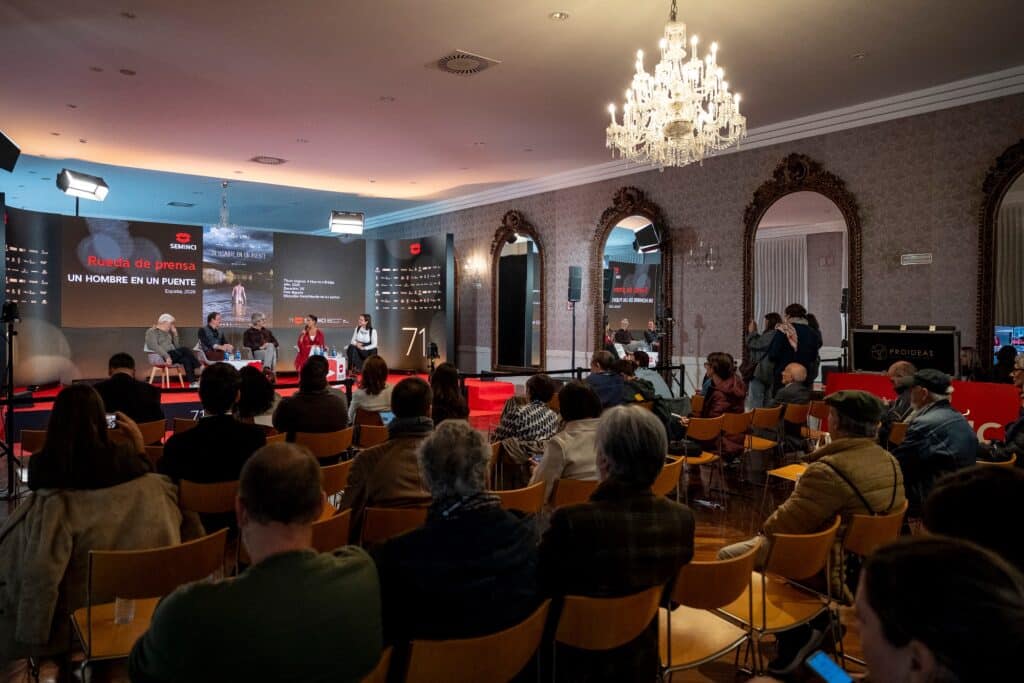
David Martín de los Santos has arrived at the 71st SEMINCI to present the world premiere of his latest feature film, Un hombre en un puente, which is screening out of competition in the Official Section. The Spanish director is accompanied by producer José Nolla, actor Roger Casamajor and actress Nidia Bermejo.
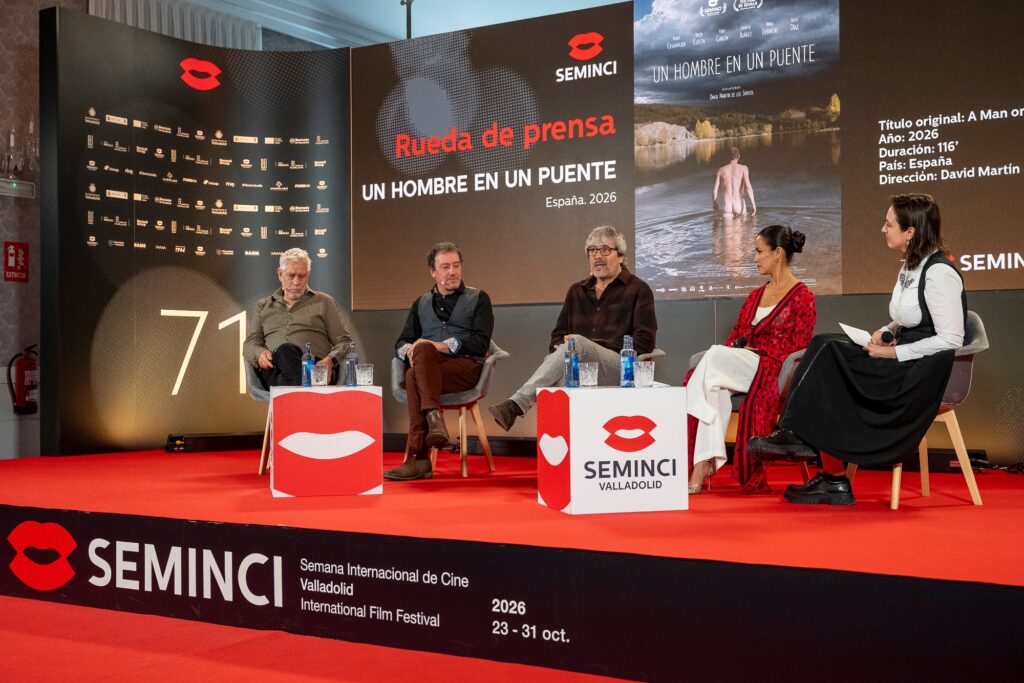
Un hombre en un puente tells the story of Andrés, a middle-aged man who, after a lifetime of questionable decisions, returns to his place of origin in the hope of finding a second chance. For this journey of return and self-discovery, Martín de los Santos chose to film in the Castilian town of Cervera de Pisuerga. “I thought of Bardem’s Calle Mayor. For me, that film opened up a very particular vision of Spain and Spanish cinema. I don’t have any personal or family ties to Castile and León, but I imagined the story taking place there and it worked very well. Cervera is a town with a great deal of texture, bearing the traces of its mining past. Its landscapes conveyed a sense of intimacy and austerity that the story called for,” he explained.
Loneliness and empathy
Roger Casamajor plays Andrés, a complex and uncomfortable character whom Martín de los Santos strives to approach with empathy. Discussing his inspiration for the character, the director explained: “What interested me was the story of a man who returns to his hometown after many years, fleeing the mistakes of his past and trying to rediscover the foundations he left behind there. I wanted to explore how he experiences everything through shame, and how that isolates him. It’s something I also see in everyday life: failure is punished, when, deep down, it is through our vulnerabilities that we connect most deeply.” He added: “I learnt to love the character and see him with humanity, without justifying him, but trying to understand everything that has brought him to this point.”
The acclaimed Catalan actor joined in this reflection, sharing the challenges of bringing such a character to life: “I worked with David from a sense of loneliness, in order to understand the downward spiral Andrés finds himself caught in. We imagined someone who had lost his humanity and devoted himself to speculation. It resonates very closely with what we’re experiencing today, with a crisis that is not just about property but also about humanity.” He added: “It is through this destruction that he can begin to create again, once he finally allows himself to accept help and learns not to be afraid of making mistakes.”
A bridge between Spain and Peru
The turning point in Andrés’s life comes through an unexpected encounter with an immigrant woman, who shows him a possible path towards redemption. “Rather than a crossing, it’s a collision between two paths,” explained Nidia Bermejo, the actress who plays Liliana. “The migrant experience has a great deal to do with losing something along the way, with the feeling that you have nothing left to lose. The film reveals a new space that opens up when we welcome migrants and work together to build something new.” She also highlighted the importance of involving other Peruvian professionals in the crew.
José Nolla also discussed the fruitful collaboration with Peru during the production and post-production stages: “It was a very difficult film to make, both thematically and narratively, because it confronts us with questions that are not often explored in cinema. Films of this kind are finding less and less room within the funding structures of independent cinema. It hasn’t received the support it deserves, and yet we’ve managed to bring it to life through the determination of those of us here and many others.”
Martín de los Santos praised this work, highlighting the need for “romantic producers who are committed to challenging projects” to continue working in the industry.
Nolla concluded: “Long live this kind of cinema, and long may SEMINCI continue to be a place we can keep coming back to. There are problems and threats ahead, but I hope you remain strong and continue to be a refuge for those of us who champion a different kind of cinema.”