
- Representatives from cinemas, distribution companies and streaming platforms have come together at the 71st edition of SEMINCI to explore common ground and build bridges.
- Mark de Quervain of Indy Cinema Group has championed the potential of AI to boost cinema attendance and improve the audience experience.
As part of the Independent Film Market – MERCI, two round-table discussions took place on Thursday 29 October, bringing together representatives from film exhibition and distribution to discuss the challenges facing the Spanish film industry today and in the immediate future.
The first discussion, entitled Cinemas, Distributors and Platforms: Working Together for Audiences, brought together executives from independent distribution companies, streaming platforms and traditional cinemas to share their different perspectives on film exhibition, how to reach audiences and how to enhance the cinema-going experience. Participants included Eva Rekettyei (Cines Yelmo), Mercedes Gamero (Beta Fiction), Octavio Alzola (Cines Renoir), José Antonio de Luna (Filmin), Íñigo Trojaola (Movistar+) and Álex Lafuente (BTEAM Pictures).
Building bridges
The three pillars of the film industry – distributors, platforms and cinemas – agreed that relations between them are becoming increasingly fluid and organic, but stressed that more bridges still need to be built. “We have to help one another. There needs to be greater variety, and a single film should not dominate the entire box office,” said Mercedes Gamero, defending the role of independent distributors and producers, whose releases are often limited to just a few weeks compared with those of blockbusters.
Representatives of Cines Yelmo and Cines Renoir, Eva Rekettyei and Octavio Alzola respectively, shared this view, pointing out that many films are not necessarily destined for traditional cinema release. “We know there is a major problem with overproduction, and we need to try to give each film the space it needs, according to its particular requirements,” Alzola noted. “As exhibitors, we simply cannot accommodate everything being produced in Spain and around the world at the moment. There is a kind of natural selection at the box office, and it creates a great many problems,” Rekettyei added.

Defending the cinema experience
The participants also addressed the major issues currently shaping their work, including excessive advertising and the lack of trailers before screenings, growing piracy and theatrical release windows. Nevertheless, everyone agreed that defending the cinema experience is paramount. They emphasised the need to work together to improve viewing conditions for audiences, highlighting the important role played by both streaming platforms and cinemas in achieving this. “The important thing is to rebuild the habit of going to the cinema among audiences,” said Trojaola, Editorial Director at Movistar+.
In this regard, they sought common ground on theatrical release windows, noting that although these were significantly shortened following the pandemic, the time films spend in cinemas before becoming available on streaming platforms is gradually being restored. “We attach great importance to the release window that allows films to enjoy a long life,” Trojaola remarked. Álex Lafuente of BTEAM Pictures added: “Audiences need to understand that there is a reason why a film is released in cinemas first, and that being the first to see it matters.”
Finally, they agreed that it had been an excellent year for Spanish cinema, thanks in many cases to recent Spanish films such as Sirat (2025) and La bola negra (2026), which have helped boost overall box-office takings. “The bigger a film becomes in cinemas, the better it is for everyone, and the greater the distributor’s capacity to bring the next one to audiences,” concluded José Antonio de Luna of Filmin.
Artificial intelligence can help cinemas
Mark de Quervain, Head of Cinema Strategy at Indy Cinema Group, delivered a short remote presentation in collaboration with Europa Cinemas, sharing his research into the use of artificial intelligence in communications for cinemas. He highlighted how advances in AI could strengthen the relationship between audiences and cinemas by making information about films more accessible, particularly when it comes to smaller productions.
He provided several examples of how an average cinema-goer might ask generative AI what entertainment options are available in their city, depending on the kind of experience they are looking for. These new tools allow search engines to provide much more personalised responses.
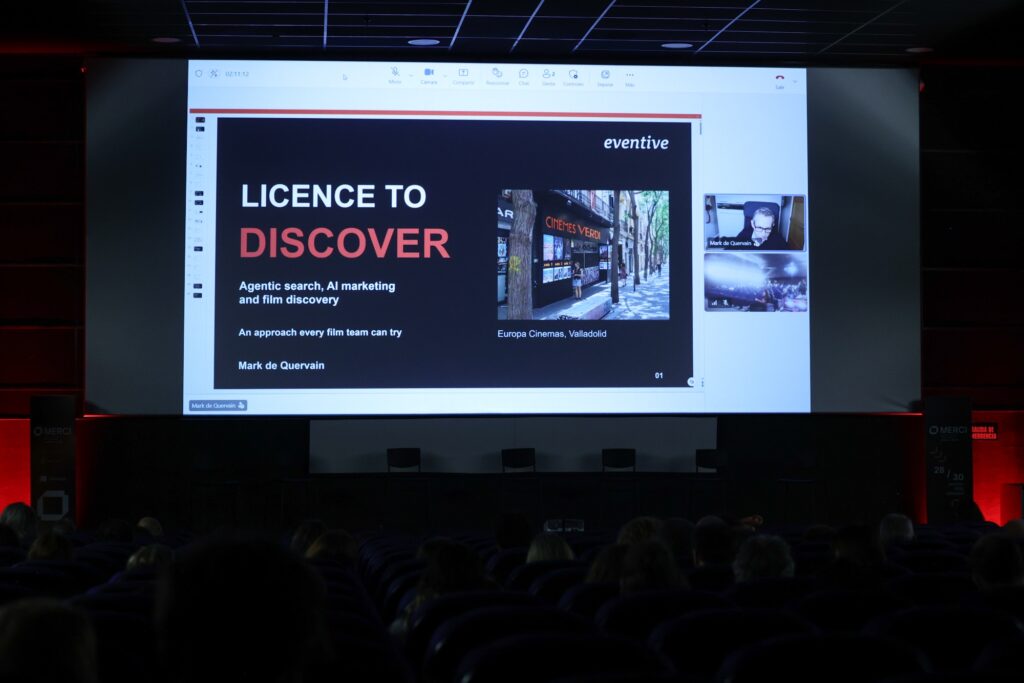
In this context, he stressed the need for distributors and cinemas to contribute as much information as possible about upcoming releases, ensuring that communications remain accurate and that the content of films is protected. “With easy-to-use tools and very little risk, we can help people find the film that interests them most,” de Quervain explained.
He also emphasised that film festivals such as SEMINCI could benefit from these applications, helping them reach more casual audiences who may not have engaged with the festival during the preceding months of preparation.