
- The Mexican star has travelled to Valladolid to present his latest feature film, which will bring the 71st SEMINCI to a close.
- Starring García Bernal, the film offers a playful yet critical look at the socio-political dynamics of Latin America and features Esmeralda Pimentel, Débora Nascimento, Manuel Garcia-Rulfo and Ricky Martin among its cast.
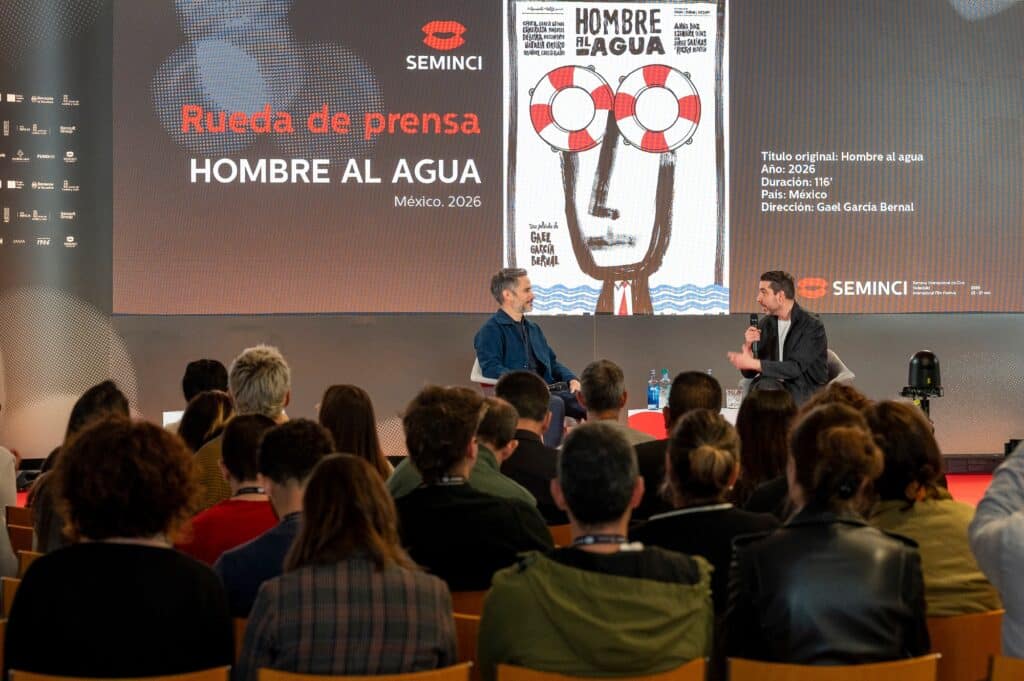
On the eve of the closing ceremony of the 71st SEMINCI, Mexican actor and director Gael García Bernal presented his latest film, Hombre al agua, which will bring this year’s festival to a close. A leading figure in Latin American cinema, García Bernal has starred in countless cult films, working with directors such as Alfonso Cuarón, Alejandro González-Iñárritu, Lav Díaz and Pedro Almodóvar. He also has an extensive career in Hollywood, in both film and television, and won a Golden Globe for his role in the series Mozart in the Jungle.
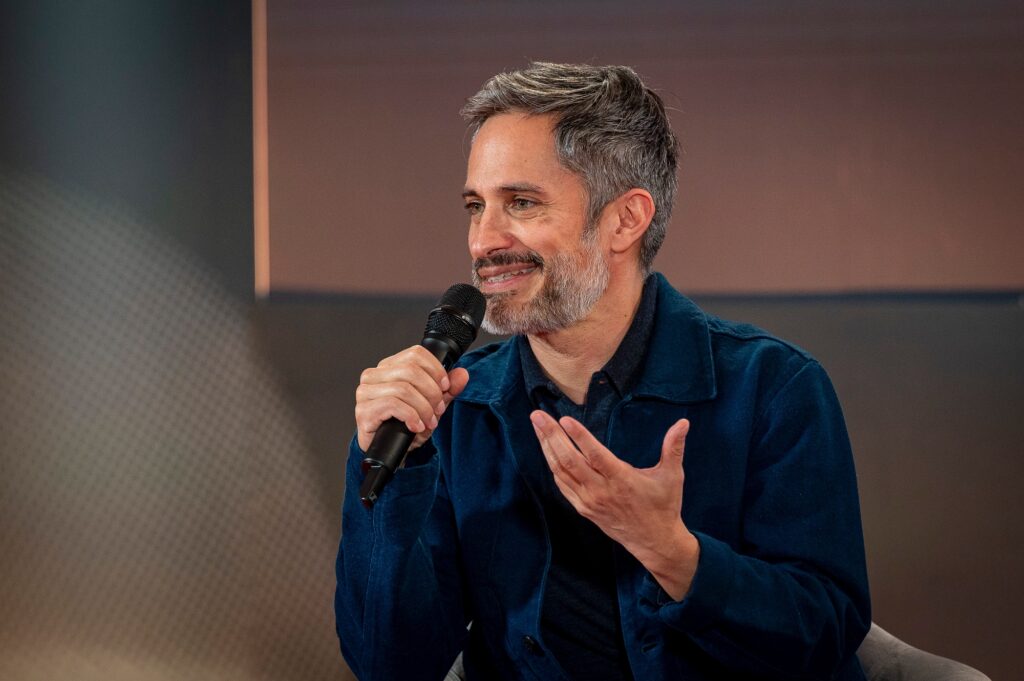
In 2007, he made his feature-film directorial debut with Déficit, a venture he followed up with Chicuarotes in 2019 and now Hombre al agua: “I want to start by expressing my gratitude for being here. It’s very special to see how the festival has appreciated the freedom with which we made this film. It was a collective endeavour, but one that grew out of my deepest concerns and curiosities. From there, I tried to put together a fable exploring several themes that interest me: the crisis of masculinity, loneliness, a separation, the political body of Latin America today… all of that is in the film”, the actor and director explained.
All that glitters is not gold
In Hombre al agua, García Bernal plays Camilo, a Cuban lifeguard who, after rescuing a businessman, embarks on an unexpected journey that takes him into the world of Mexico’s upper classes. But, as he soon discovers, all that glitters is not gold, paving the way for a biting political satire built around what the filmmaker describes as the classic “genie in a bottle” narrative.
Speaking about the nuances of Camilo’s character, he added: “The fact that he was Cuban came about rather late in the process. As a Mexican, I have a close relationship with Cuba, and making the character Cuban gave him a complexity that made him more interesting. He’s someone who is trying to survive, who gets rescued, just as he rescues Abel, the millionaire. It was a challenge, but as I always say, if we’re going to make a film, we might as well make things difficult for ourselves”.
Through these details, García Bernal pieces together a puzzle that explores the contemporary socio-political landscape of Latin America from multiple perspectives. “Films are a faithful record of the time in which they are written and also the time in which they are made. When I first started thinking about this film, Lula was in prison. I imagined making an anti-telenovela, as if Globo had commissioned Carl Dreyer to make a telenovela about Lula’s trade union years. All these elements gradually shaped the path towards a film that is very much a tribute to my own history on the continent”, he explained.
Theatre and comedy
Playwright and theatre director Mariano Pensotti co-wrote the screenplay with García Bernal, giving the film a theatrical quality to which the Mexican filmmaker has always felt closely connected. Reflecting on this relationship, he said: “I grew up surrounded by experimental theatre with my parents, and being immersed in that world allowed me to appreciate it as a temple, a safe place where you could experiment with anything. Cinema today, unfortunately, is governed by a more corporate mindset that places limits on all of that”.
He also praised the creative partnership with Pensotti: “Whenever I start making a film, I imagine the opening scenes. From the very beginning, I knew I wanted to call Mariano. He’s the theatre director I would like to be. His plays embrace a free-spirited, unruly approach, taking everything somewhere very intimate. We’re also very close friends, and creating something from that place is wonderful”.
Another central aspect of Hombre al agua is its use of comedy to explore serious and topical issues. “Humour is a sharp edge that opens doors and makes things more complex”, García Bernal remarked. “Reality constantly outdoes us, and sometimes we need to step back so that, from a distance, we can see just how ridiculous and absurd the situations we live through really are”.
He concluded: “I’m more optimistic than pessimistic. I always want to see the light, and I hold on to the open-ended question at the heart of the film. I wanted to make the kind of film that Luis Buñuel and Jean-Claude Carrière would have liked”.