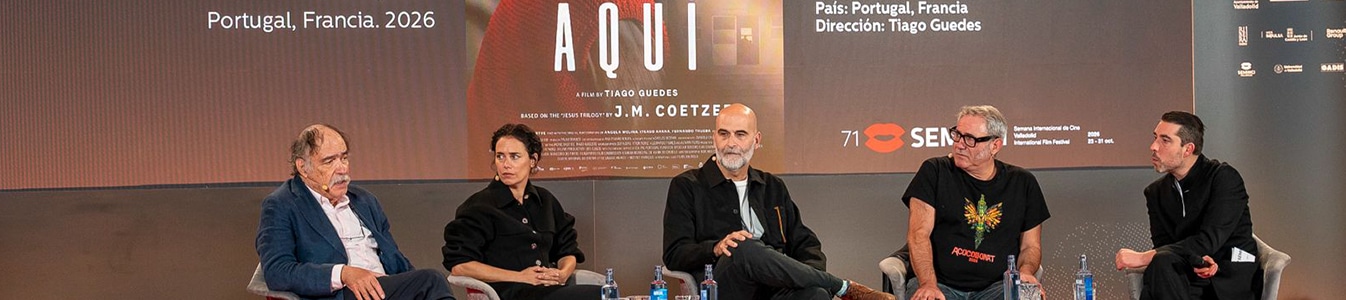
- The Portuguese director and other members of the cast and crew have travelled to Valladolid to present the Spanish premiere of the latest film starring the Spanish actor, who died in July.
- The Spanish-Portuguese co-production arrives at the 71st edition of SEMINCI, where it is competing for the Golden Spike following a successful run at the Cannes Film Festival.
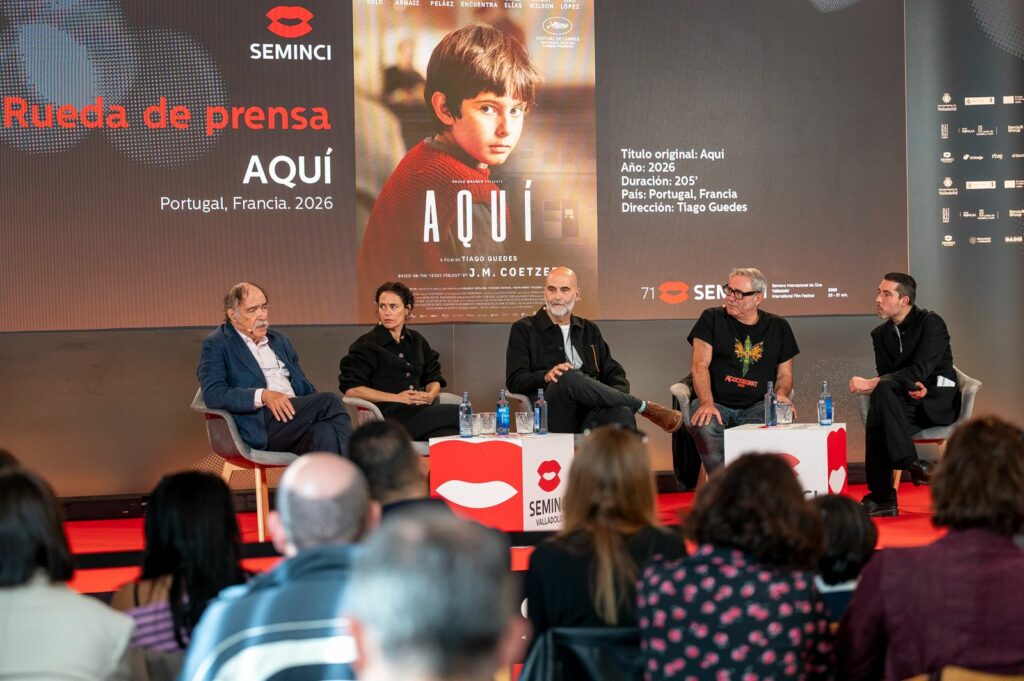
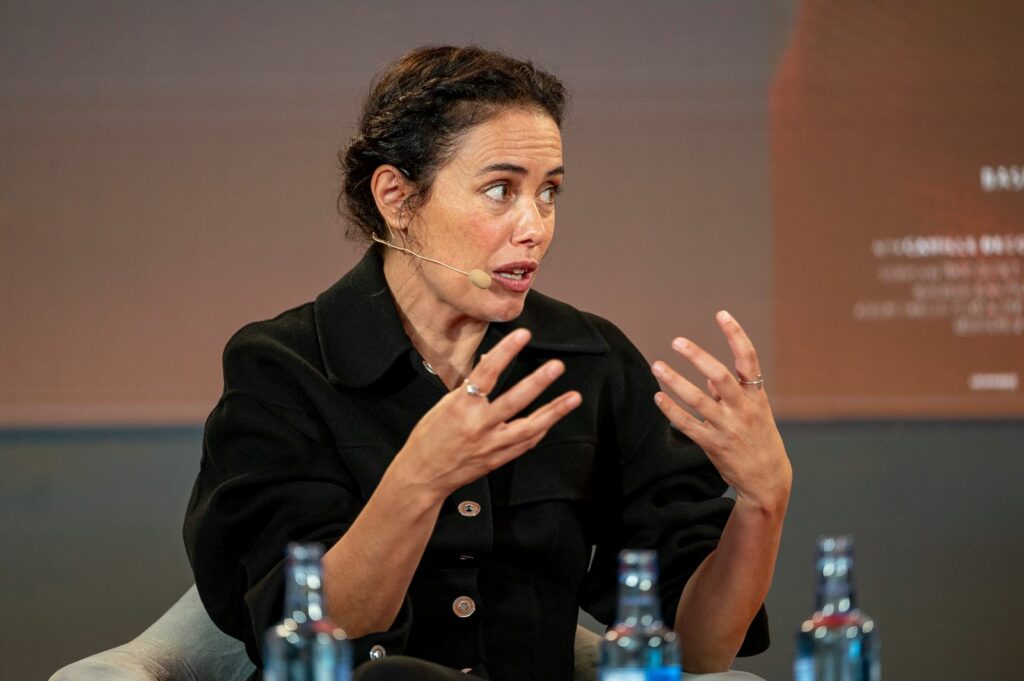
Valladolid, 26 October 2026. — Javier H. Estrada, co-director of SEMINCI, welcomed the team behind Here to Valladolid. The film is competing in the Official Section of the festival’s 71st edition. Director Tiago Guedes attended the press conference alongside producer Paulo Branco and actors Patricia López Arnaiz and Sergi López.
The team dedicated the film’s Spanish premiere to Spanish actor Manolo Solo, who co-starred in the film before his death in July this year. “I saw Manolo in Erice’s film (Cerrar los ojos) and sensed a sensitivity that resonated with what I was looking for in the character of Simón in my film. It was very easy to talk to him, and he was someone who showed enormous generosity,” Guedes said.
The Jesus Trilogy
Aquí adapts the Jesus Trilogy by South African novelist J. M. Coetzee, a work that explores questions of identity and migration in an imagined world through a deeply philosophical lens. Speaking about the path towards adaptation, Branco explained: “I’ve been fortunate enough to know Coetzee for several years, and when I told him how enthusiastic I was about the books, he said he would give me the rights. He had received many offers from the United States, but none interested him, and he didn’t want the film to be in English. Later, Tiago and I went to meet him in Córdoba, and he trusted us to remain faithful to the source material.”
Although the adaptation was a successful undertaking, it was not without its challenges, particularly the need to condense a work of more than 900 pages into a film lasting three and a half hours. Guedes explained: “We wanted it to be three hours long, but when we watched it, we realised that was the final cut; there was nothing else to remove. I really like that running time because it allows for genuine immersion. You spend that time inside that world, away from second or third screens. I think that, today more than ever, making a long film is an act of resistance.” “The film is an abridged version; three hours is practically a short film,” Sergi López added, laughing.
Here and now
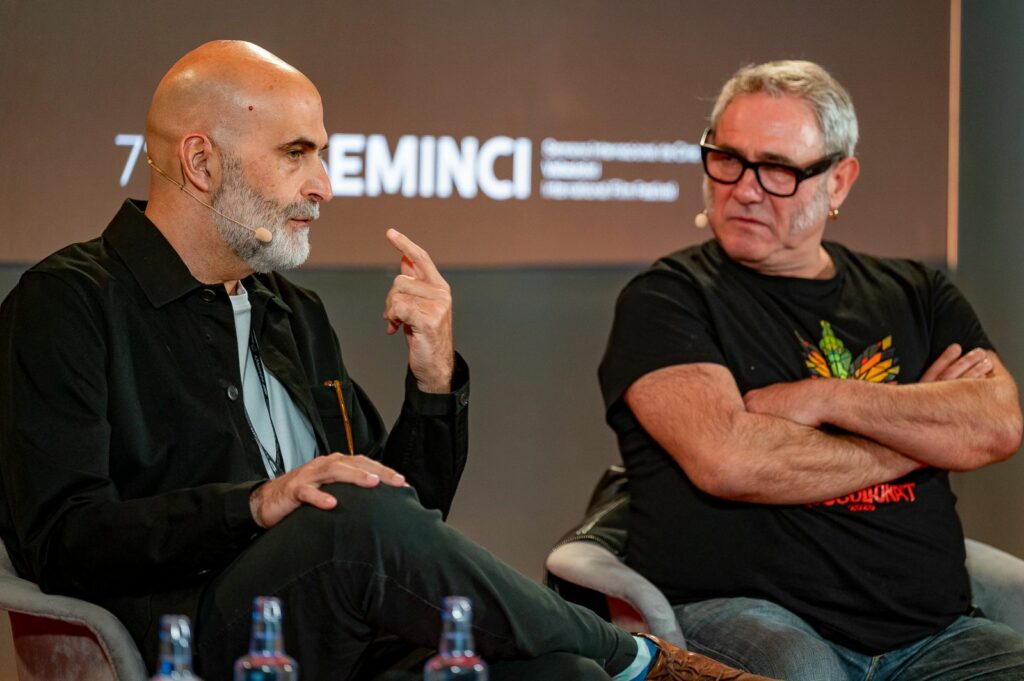
One of the film’s departures from the source material is its title, which the director and producer discussed with the author. “The film says a great deal about the importance of living and being in the moment. There are no memories, and the future is uncertain; what matters is the precise moment the characters are living through. There is a very powerful scene in which David asks Simón, ‘What are we doing here?’ and Simón cannot give him an answer. We put all these ideas to Coetzee, and he really liked them,” Guedes explained.
Sergi López added: “It could be called Here and Now, but really, it’s forever. It’s the present, but an eternal present.” The actors also explored the challenges of portraying ambiguous characters in a world that exists beyond reality. “When you’re lucky enough to read such a solid script, set in such a different universe, there isn’t much room for improvisation. We’re not used to playing characters without a real-life backstory, where what matters most is the poetic and symbolic dimension,” Sergi López observed.
Patricia López Arnaiz reinforced this idea, explaining: “It was a role we had to approach with great respect, not only because of the material we had to take care of, but also because of its particularities. There is an atmosphere of unreality, a sense of strangeness that exists in the books and was also present in the script. When I work on realistic productions, I can improvise and come up with little gems that serve the work, but that wasn’t the case here. The responsibility lay with Tiago’s external vision, and we had to trust it.”
“It’s a film that will reveal much more about the world already present in Coetzee’s text,” Branco concluded. “For me, the film has no bottom; that is thanks to Tiago’s work with the actors.”