
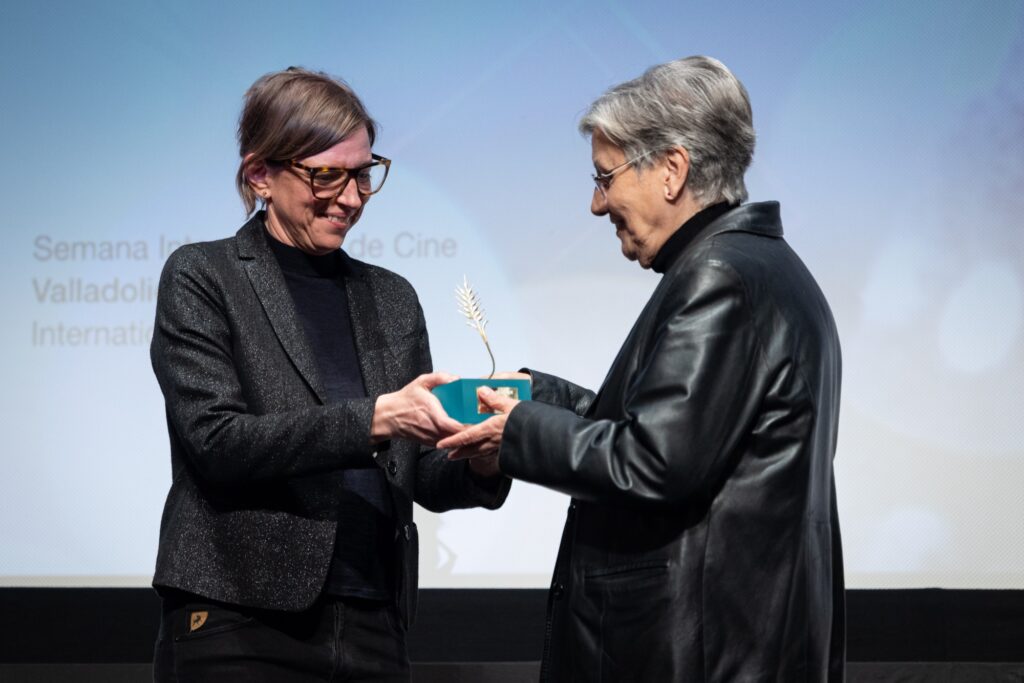
- The director, screenwriter and editor received the award at the Teatro Zorrilla, reflecting on the connection between her filmography and SEMINCI.
- The festival’s co-directors, Javier H. Estrada and Mariona Viader, paid tribute to the victims of the railway accident and once again expressed their condolences, offering their support to all the families affected.
The 71st edition of SEMINCI has presented the Honorary Spike to Valeria Sarmiento, one of the most influential voices in Latin American cinema, in recognition of five decades of work in the film industry. The festival’s co-directors emphasised the importance of Sarmiento’s contribution as a filmmaker who, from the very beginning of her career, has reflected on gender roles and challenged them in her films.
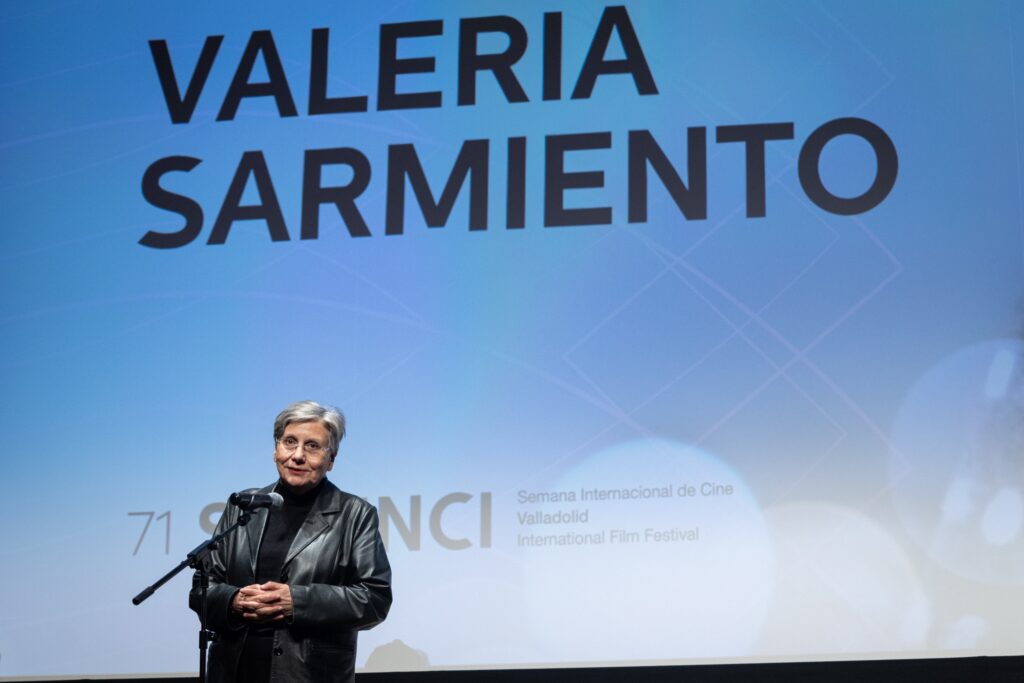
Her cinema, which has explored every genre and maintained a particularly close relationship with documentary filmmaking, has a special connection with SEMINCI. As the filmmaker recalled, one of her early works, El hombre cuando es hombre, was screened at the 27th Valladolid International Film Week in 1982. “It is curious that I visited Valladolid at the beginning of my career and am now returning with one of my latest films,” Sarmiento remarked, expressing her joy at feeling that both the beginning and the end of her filmography are linked to a place such as SEMINCI.
To mark the occasion, a tribute video celebrating the filmmaker was also screened, tracing her eclectic and committed career, from her early short films, such as Un sueño de colores (1973), through her documentaries and historical films — Maria Graham (2014) and El cuaderno negro (2018) — while also recalling her numerous collaborations with Raúl Ruiz, including El tango del viudo y su espejo deformante (2020) and Realismo socialista (2023).
This was followed by a screening of her latest feature film, Detrás de la lluvia, which premiered in Spain this afternoon in Valladolid. As she explained at the press conference the previous day, the film’s title originated from a screening she attended with her mother, during which the print of The Red Shoes (1948) was damaged, creating the impression that rain was falling in front of the images.
Before the film began, Sarmiento addressed the audience in Valladolid, inviting them to look beyond the rain to discover what her film conceals. “As writers say, this film has been in the pipeline for a long time, more than twenty years. It is a work deeply connected to my personal experience,” the filmmaker concluded after receiving the award.