- The Austrian filmmaker is competing in the Official Section of the 71st edition of SEMINCI with his third feature film, starring Sandra Hüller
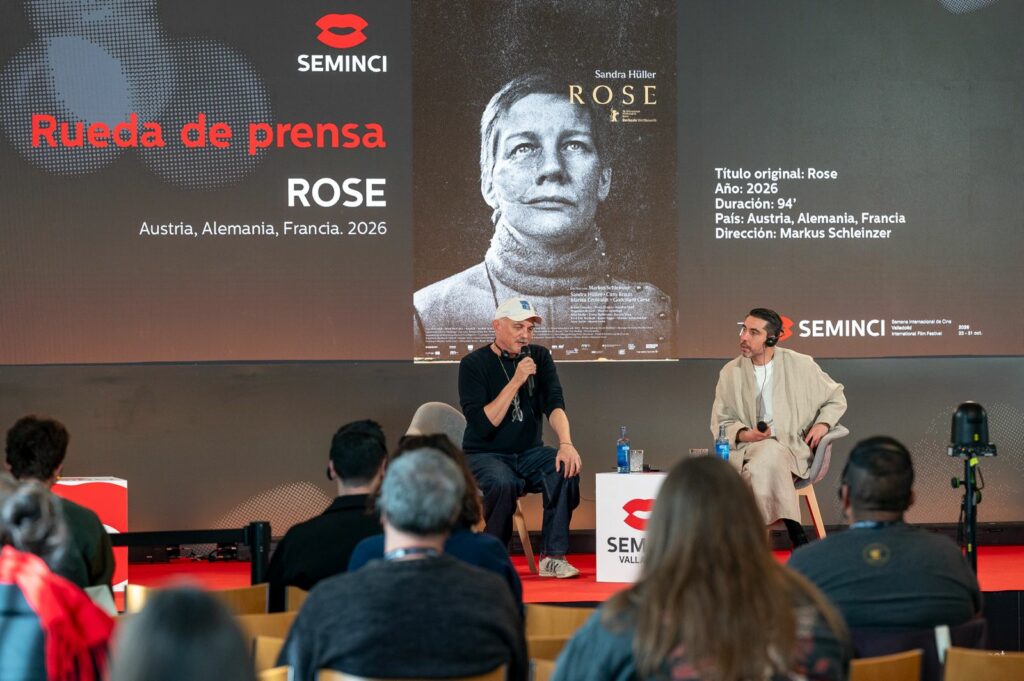
The Official Section of the 71st edition of SEMINCI hosted the Spanish premiere of Rose, the third feature film by Austrian filmmaker Markus Schleinzer, a drama inspired by real events and set in 17th-century Germany, which tells the story of a woman who pretends to be a man. The filmmaker presented this film today in Valladolid, starring Sandra Hüller, winner of the Silver Bear for Best Actress at the Berlinale.
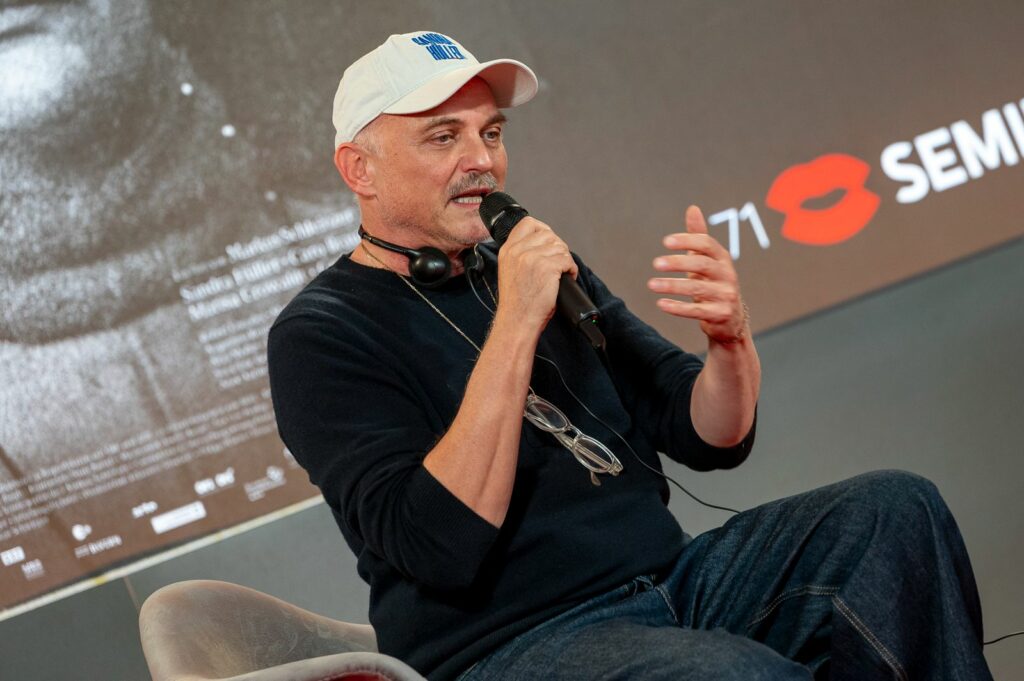
One of the film’s cornerstones is its historical setting, which stems from a lengthy research process undertaken by the filmmaker, who read accounts of this kind of behaviour recorded during the Modern Age: ‘I discovered another three hundred women who tried to escape the constraints imposed on their gender. The actual figure is likely to be much higher, as these are only the people who were discovered or captured,” Schleinzer explained, noting that what moved him most about these stories was the diversity of reasons that led these women to decide to pass themselves off as men, whether in times of war, to escape abuse or to gain access to an education. “The aim was always the same: to gain more freedom,” she added.
The filmmaker has also reflected on the stark visual style underpinned by the use of black and white, the result of his collaboration with director of photography Gerald Kerkletz: ‘Black and white implies a reduction in content, in information. This means that everything is more concentrated, and what remains takes on greater force,” he explained, pointing out that the absence of colour forces films to be told by the actors rather than by elements external to them. “Ultimately, for me, black and white is a tool, a narrative medium. And Rose is a film about the very act of storytelling,” he added.
A role written for Sandra Hüller
Schleinzer, a renowned casting director for films such as Michael Haneke’s The Piano Teacher (2001) and The White Ribbon (2009), who has also worked with filmmakers such as Ulrich Seidl and Jessica Hausner, has stated that the only decision he was certain of from the outset was that the lead role should be played by Sandra Hüller, known for her roles in films such as Toni Erdmann (2016), Anatomy of a Fall (2023) and The Zone of Interest (2023). “I wrote the role for her. She is, without a doubt, the best German-speaking actress working today and probably one of the best actresses working anywhere in the world right now,” said the filmmaker, highlighting his experience spanning more than seventeen years in the German-speaking film and theatre world, which has allowed him to witness the development of many actors and actresses over time.
He also elaborated on his particular writing process, which resulted in a script running to hundreds of pages that he had to condense in order to adapt it for the screen: “I always write in prose because it allows me to capture the inner world much better: what the characters think, what they feel, their doubts, their virtues and their flaws, their wounds and their burdens,” he explained, acknowledging that he did not set out to write a conventional screenplay from the outset, but rather a much more detailed work.
Championing dissent
Rose’s story can be interpreted as a universal tale of those whose identities are denied or silenced by the rest of society – an enduring problem that the director has sought to explore: ‘I believe that change can only come about outside the norm. If we only do what is expected, then there is never any change,” he stated. He also emphasised that the film is yet another instalment in a body of work dedicated to exploring the lives of the “marginalised”: “I have always made films that question how we treat people who are different. Sandra always says that Rose is a declaration of love for all those people who are not allowed to live their own lives,” he concluded.
Finally, Schleinzer reflected on the film’s selection as a nominee for the Oscar for Best International Feature Film, admitting that, for him, the greatest reward is for the film to reach as many viewers as possible and the opportunity to share conversations and encounters with the audience, such as the one that took place today in Valladolid. “Regardless of whether we win an award or not, the work is already done: the most important thing is the act of making films,” he said.