
- The Danish director presents *Woman Unknown*—winner of the Golden Lion at Venice—at the 71st SEMINCI, a film about the social condemnation of women in the postwar era and the mechanisms of control that persist today
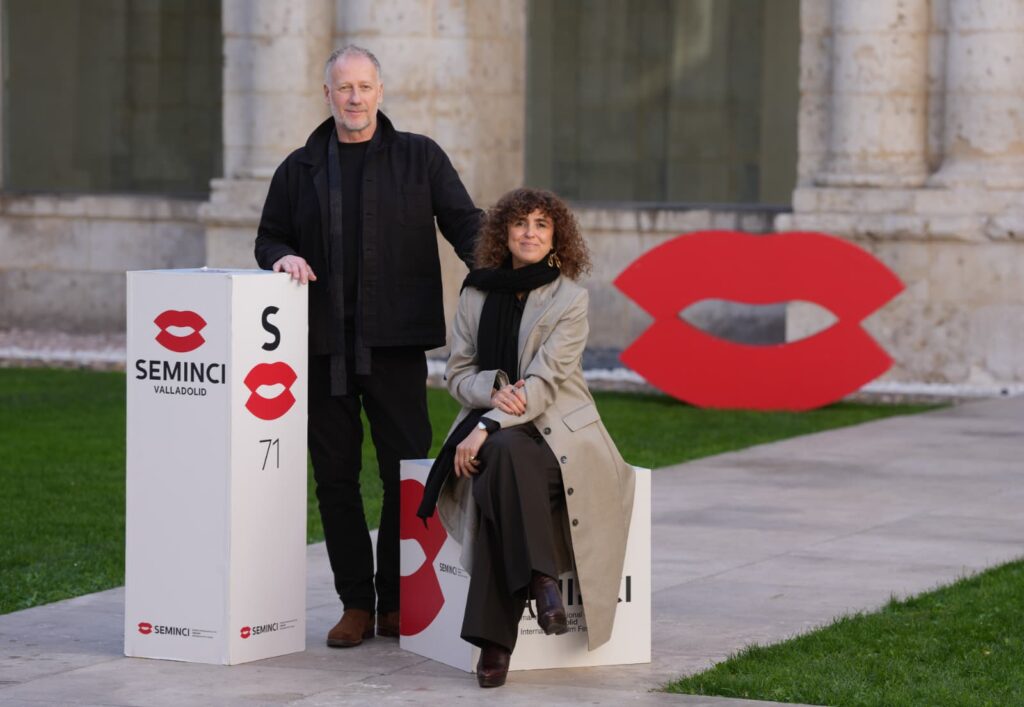
Historical memory, the construction of collective narratives, and control over the female body run through Woman Unknown, the film with which Danish director and screenwriter May el-Toukhy won the Golden Lion at the Venice Film Festival and which is competing for the Golden Spike at the 71st Valladolid International Film Festival. The filmmaker presented this film today in Valladolid; it is set in postwar Denmark and stars Mathilde Arcel, who was awarded the Volpi Cup in Venice.
The film recounts the story of women who, following the German occupation, were singled out and punished for having relationships with soldiers from the enemy side. While researching this period, el-Toukhy discovered how collective memory had helped construct an idealized image of the Danish resistance. “In a way, we rewrite history to adapt it to our collective identity and regain our self-respect,” she says. The women thus became symbols onto whom a society—which also had to confront its own collaboration with the enemy or its passivity during the occupation—could project its guilt and shame. “We must allow complexity to be part of our conversations, even if that makes things harder to understand than when we reduce them to a black-and-white opposition.”
The Female Body, Between History and the Present
The historical reflection in Woman Unknown connects to forms of control that, according to the filmmaker, remain present today. “Women’s bodies continue to be a battlefield. Sexual violence occurs during wars and in their aftermath, in every country around the world.” El-Toukhy links this violence to a conception of the female body as collective territory, but also to the demands that shape women’s daily lives. “The popularity of drugs like Ozempic and Wegovy and the return of extreme thinness as a beauty ideal are part of that same structure that shapes the presence of the female body in public space.” In the film, the director examines how this control manifests itself in both the social and domestic spheres, without attempting to offer definitive answers.
Inequality Also Shapes the Cinematic Gaze
The Venice experience has led May el-Toukhy to reflect on gender inequality in the industry. The director recalls that she was the only woman competing on her own in the festival’s official selection and believes that the undervaluation of female filmmakers stems from a structural problem. “There is a tendency to construct a narrative around male directors as if they were geniuses, while the same recognition is not extended to women.”
El-Toukhy argues that the debate on equality must coexist with a focus on artistic work. “It’s also important to talk about artistic decisions and the filmmaking process itself. That doesn’t mean we should stop debating equality: we have to keep doing so until men and women have equal opportunities in the industry.” The filmmaker also questions why stories starring women face greater difficulties in securing funding and getting into film festivals, partly because, in her view, female viewers are more accustomed to identifying with male characters than men are to putting themselves in the shoes of female protagonists.
A Distinctive Voice in European Cinema
Following her recognition at Venice, the director is embarking on a period of travel and meetings that she values for the opportunities they offer, though she also warns of the financial challenges involved. “Winning one of the major European awards can be the fastest route to bankruptcy. Suddenly, you might find yourself traveling the world with your film, but you can’t work or make any money,” she explains.
El-Toukhy affirms her connection to European cinema and the need to preserve sustainable production conditions. Woman Unknown was shot in five weeks and three days, a schedule she considers difficult to maintain. Although she doesn’t rule out working in the United States, the director identifies with a cinematic tradition that allows her to develop her own perspective: “I don’t want to close any doors, but I believe my voice as a director is a European voice.”