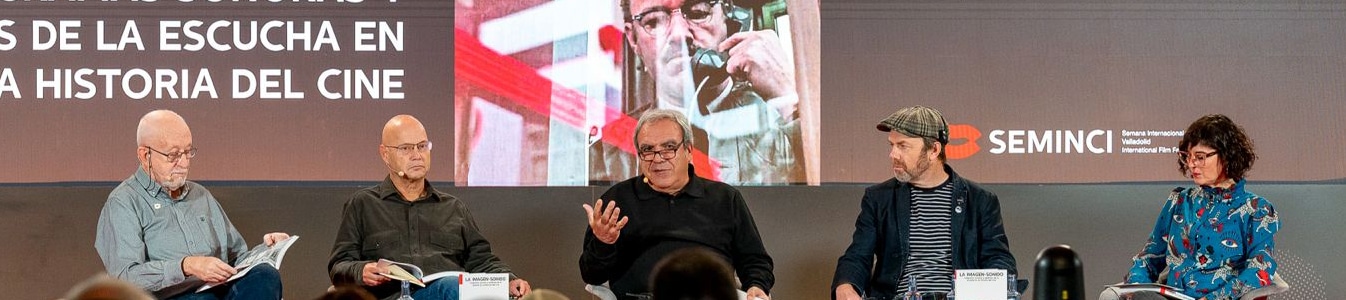
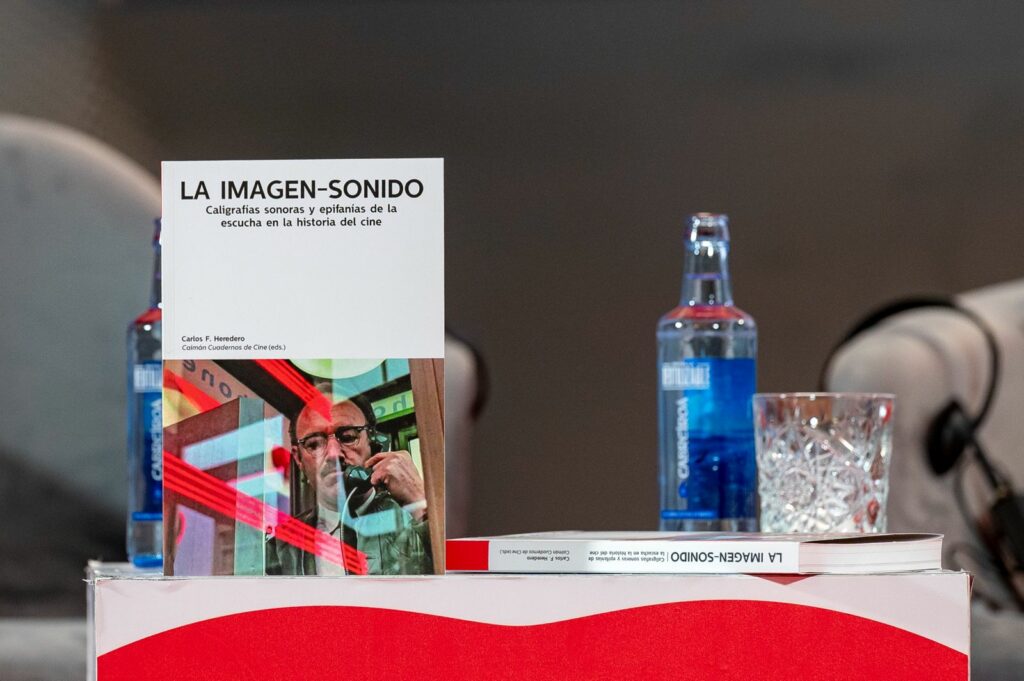
- The 71st edition of SEMINCI has hosted the presentation of the book, published in collaboration with Caimán Cuadernos de Cine. Those attending included Carlos F. Heredero, the book’s coordinator; contributors Carlos Losilla and José Antonio Hurtado; and sound recordist Tarn Willers.
As part of the series of events organised by the 71st edition of SEMINCI under the title ‘Thinking About (and Listening to) Cinema’, the book ‘The Image-Sound: Sonic Calligraphies and Epiphanies of Listening in the History of Cinema’ was presented. Published in collaboration with Caimán Cuadernos de Cine, the book was discussed by several of its contributors, who explored its contents and took part in an open conversation with audiences in Valladolid.
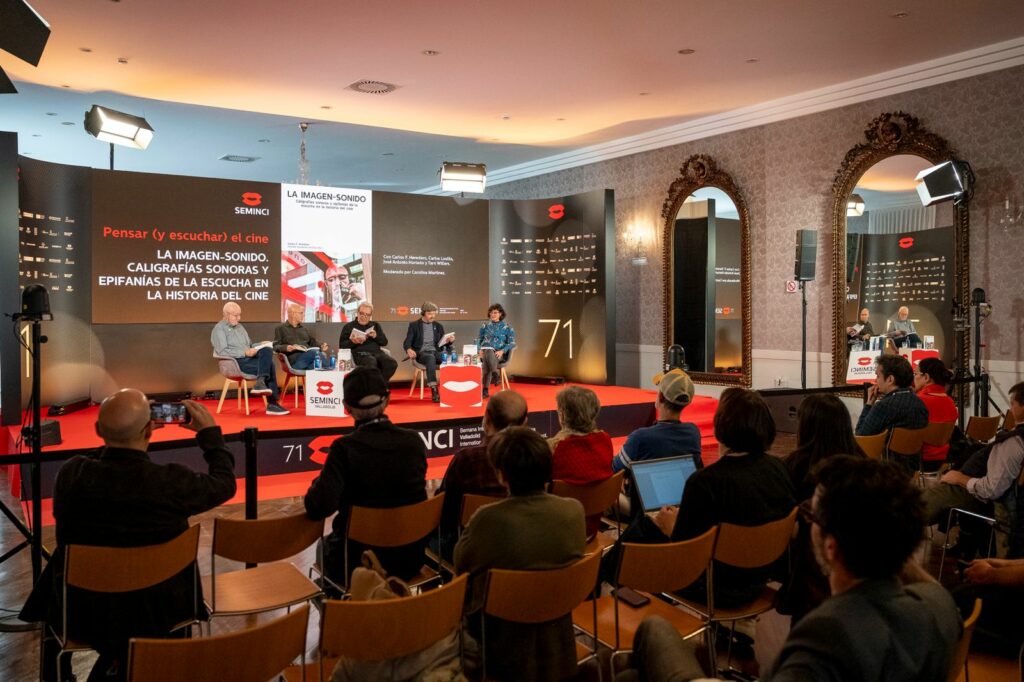
Carlos F. Heredero, editorial director of Caimán Cuadernos de Cine and coordinator of the book, praised the considerable work undertaken by all the contributors and highlighted the publication’s potential importance within Spanish academia. “This book required a collective perspective to explore that blurred boundary we call sound cinema,” Heredero explained, noting that cinema has always had a sonic dimension, even during the silent era, since films were invariably accompanied by music.
The book thus explores the dialectical relationship between sound and image, drawing on the Soviet theories of Eisenstein, who argued that sound could evoke images just as images could always lead to specific sounds, as the contributors explained.
A brief history of sound cinema
The book is divided into several sections: a methodological reflection on the use of sound in cinema, a study of key filmmakers in the history of sound cinema and, finally, an analysis of a series of films that illustrate pivotal moments in the evolution of sound.
In this regard, Carlos Losilla, film critic and member of the editorial board of Caimán Cuadernos de Cine, explained that his intention was to present a kind of history of sound cinema culminating in contemporary cinema as a major turning point. “Contemporary cinema emerges as a place of learning, a new horizon that brings together the journey travelled by classical cinema and modern cinema,” Losilla explained.
Regarding the book’s second section, José Antonio Hurtado, head of programming at the Filmoteca Valenciana and member of the editorial board of Caimán Cuadernos de Cine, briefly discussed his chapter on the cinema of Wim Wenders. “Wenders always used to say that it was impossible to think about his images in the absence of music,” Hurtado noted, arguing for the need to champion a film such as Lisbon Story (1994), in which the German filmmaker constructs the soundscape of the Portuguese capital through the poetry of Fernando Pessoa.
Multiple perspectives and professional experience
Alongside theoretical essays and film analyses, Heredero explained that the decision had been made to include contributions written by industry professionals. These include Spanish sound recordists Eva Valiño and Amanda Villavieja, as well as Tarn Willers, who joined the other contributors for the presentation.
Willers, who won an Oscar for his work on The Zone of Interest (2024), discussed his collaboration with filmmaker Jonathan Glazer on a film that had to be constructed around what takes place off screen. “He explained to me that the technical crew on set would not be visible to the actors, who would be free to move around the rooms. We had to mic the entire house, the garden and the actors so that we would have plenty of audio sources for Jonathan to use later,” the sound recordist explained, describing it as a highly unconventional approach to sound design. “He told me he was less interested in the dialogue than in everything happening around it, such as doors or footsteps,” he added.
Together, the speakers concluded that the real revolution in contemporary cinema sound lies in its sensory power and the way it interacts with images. “The eye processes images, but sound is received through the limbic system without passing through the brain, which makes our perception much more emotional,” Willers explained. Losilla added: “This shift in the sound of contemporary cinema probably has less to do with technological progress than with how sound is used, having opened up a new kind of expressiveness.”
The book’s publication forms part of a wider programme of discussions on the role of sound in cinema held throughout the week in Valladolid, alongside the exhibition ‘Rugido humano, clamor de la tierra. Habitando el sonido’ (Human Roar, Cry of the Earth: Inhabiting Sound) and a retrospective tracing the history of sound cinema.