- A justice-seeking prosecutor taking on the far right, an Italian archive dismantling the Soviet empire, a road trip from Vienna to Salzburg, childhood novenas and sound received through the limbic system: a day of cinema that challenges, remembers and celebrates.
- SEMINCI joined the mourning for the victims of the serious railway accident in the province of Toledo with a minute’s silence at 8 pm and the cancellation of the SEMINCI nights performances.
The sixth day of the 71st edition of SEMINCI brought together filmmakers from across the world at the Teatro Zorrilla, Cines Broadway and Teatro Calderón. German-Iranian filmmaker Faraz Shariat and French-Senegalese director Alain Gomis presented their films in competition, while Chilean filmmaker Valeria Sarmiento received the Honorary Spike Award and premiered her latest film, Detrás de la lluvia. At Punto de Encuentro, Brazilian director Gabe Klinger and Spanish filmmaker Ledicia Sola took part in discussions; at Time of History, Ukrainian filmmaker Sergei Loznitsa presented his work; and at Alchemies, Serbian director Ivan Marković and German filmmaker Sebastian Brameshuber showcased their films. Winemaker Victoria Pariente and chef Karlos Arguiñano shared the Cine Gourmet gala, while the entire day was marked by remembrance of the victims of the serious railway accident in the province of Toledo, with a minute’s silence at 8 pm and the cancellation of the SEMINCI Nights performances.
Official Section: cinema that sabotages, and a wedding between two continents
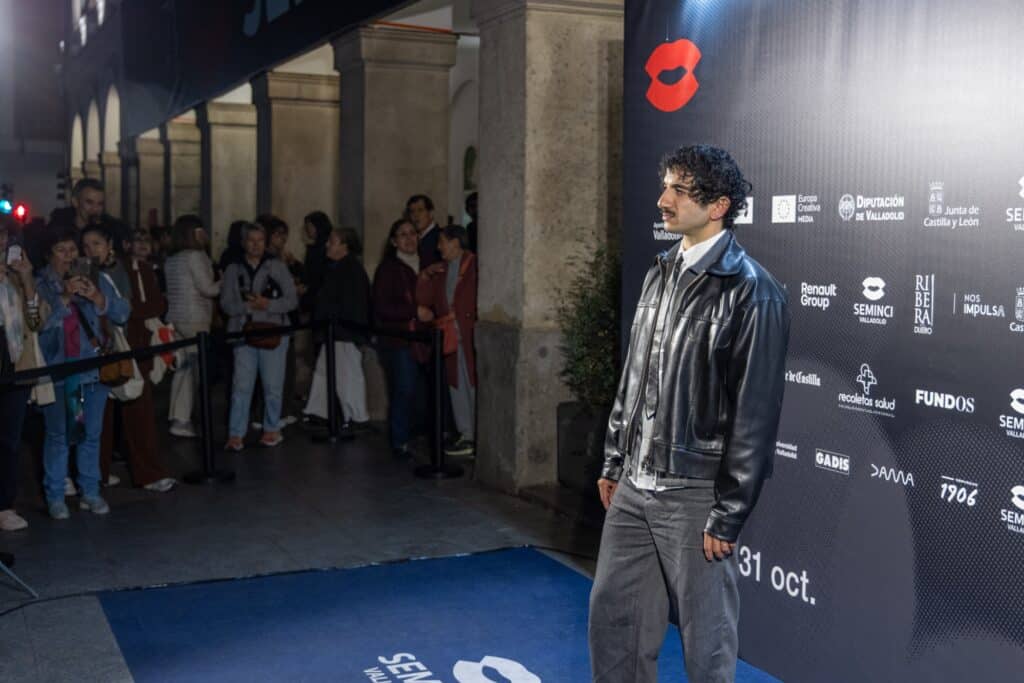
Faraz Shariat, winner of the Audience Award in the Berlinale’s Panorama section, presented the Spanish premiere of Prosecution, his second feature film, which is also competing in SEMINCI Youth. Blending drama and thriller, it follows a young prosecutor, played by debut actress Chen Emilie Yan, who is determined to confront far-right violence and investigate her own racist assault. The director spoke frankly about the current climate: “In Germany and across Europe, we are experiencing a rise in the far right. This film has a great deal to say about the present moment, but also about the history of right-wing violence and fascism that the country has always experienced.” He recalled that, at the Berlinale, the words of jury president Wim Wenders about separating art and politics “felt like a slap in the face”, and defended a different vision of cinema: “I don’t want cinema that distracts us or helps us escape from the world. I want cinema that intervenes and sabotages, that puts its finger on the wound.” Nevertheless, he concluded on a hopeful note: “We must keep believing that another world, one in which fear changes sides, is possible.”
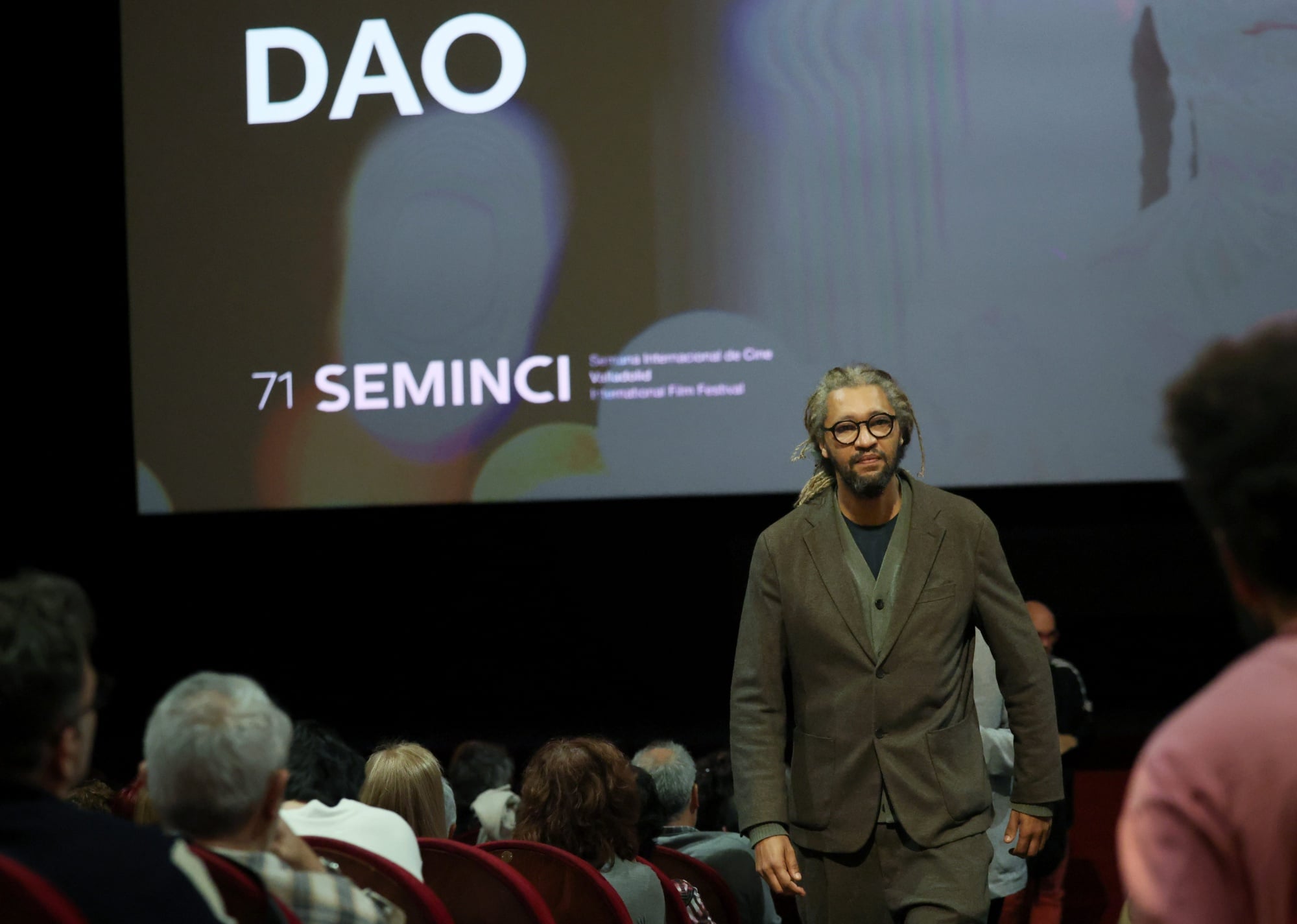
Alain Gomis, who made his fiction debut 25 years ago with L’Afrance, is competing with DAO, which presents two celebrations involving the same family in parallel: a wedding in France and a ceremony honouring the ancestors in Guinea-Bissau. He spoke about the filming process: “We were all equal on set and had the opportunity to explore questions that people don’t normally ask in everyday life.” They filmed very long takes, and after just five minutes the action had already moved beyond what was written in the script, something he found fascinating: “It was as though I were watching the film from the set itself.” He was equally clear about European identity: “It is not a question of domination, but of learning to live together and build a community.” He described his film as a blues piece: “What matters is sharing a moment and feeling that we are part of something greater than ourselves. That is what cinema means to me: being together, embarking on a journey and feeling good.”

Valeria Sarmiento: looking behind the rain
Chilean filmmaker Valeria Sarmiento received the Honorary Spike Award at the Teatro Zorrilla and presented the Spanish premiere of her latest film, Detrás de la lluvia, in the Official Section. The title originated in a memory: a badly damaged print of The Red Shoes in which it seemed to be raining in front of the images. “My mother used to tell me that I had to look behind the rain. To discover the real mysteries of films, you have to look behind the rain,” she explained. Shot in her hometown, the film had been in the making for more than twenty years and was finally brought to life with the help of people close to her: “It is a film made by friends, with a collective spirit.”
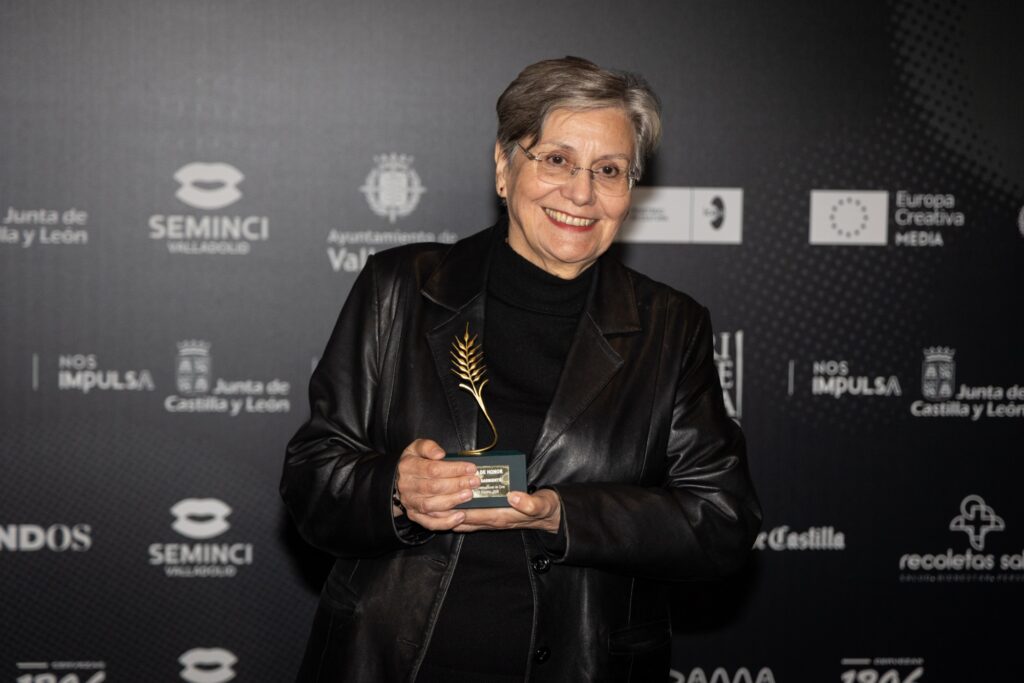
Sarmiento, who has lived outside Chile for more than fifty years following the coup d’état, recalled that her cinema has never been afraid to mix genres: “As Vargas Llosa used to say, we Latin Americans move very quickly from popular genres to high culture. It is important not to take ourselves too seriously.” She also lamented the absence of Latin American cinema from the lists seeking to establish a cinematic canon: “I have found it much easier to make films in France than in Chile.” She also spoke about Raúl Ruiz, her husband, whose unfinished films she has completed over the years: “Raúl made 120 films and left four or five unfinished. I wanted to complete them because they are part of Chile’s cultural heritage.” On receiving the award, she recalled her appearance at SEMINCI in 1982 with El hombre cuando es hombre: “It is curious that I visited Valladolid at the beginning of my career and am now returning with one of my latest films.”
Meeting Point: a wine bar in São Paulo and childhood novenas
Brazilian filmmaker Gabe Klinger presented Isabel, a Brazilian-French co-production that, somewhat unexpectedly, came into being during the pandemic: “We were alone, I was drinking quite a lot of wine, and I came up with the idea of making a film about someone who opened a bar. It came from a feeling of wanting to open myself up to the world, of wanting to be around people again. I wanted to turn wine into a metaphor for collective life, for sharing with others, just as we do through cinema.” Isabel, the protagonist, is based on Klinger himself, with contributions from Marina, the film’s screenwriter and lead actress. The director wanted to portray people in their fifties, approaching sixty, who are looking to start over: “At first, this is not particularly glamorous and is quite complicated, but I felt that need.”
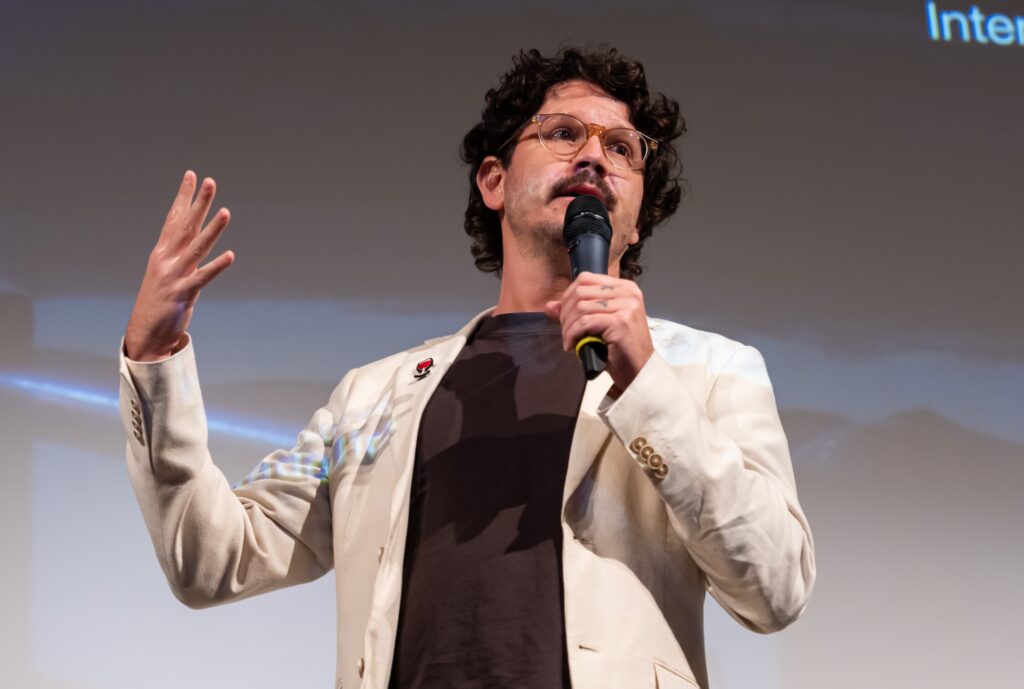
Men deliberately disappear from the film: “I didn’t want failure or success to be linked to the men around her. It is a melancholic film, with successes and failures… if you fail, you fail on your own, and that is what matters. Failure is part of life; we all have a vulnerable side.” São Paulo is another character in its own right: “The individual is a threat, and the city becomes hostile towards those who pursue their projects alone.” The shoot had its challenges. The wine seen in the film is real, not grape juice, which meant having to be careful about how much was consumed. Shooting on 16mm gave the film the vivid texture he was looking for, in parallel with the wine itself, as both involve chemical processes: “They are a metaphor for things that are genuinely made, for what is natural.” However, there were no film laboratories in São Paulo, so the footage had to be sent to London for processing, increasing the budget. Finding the right balance between melancholy and humour, and revealing the protagonist’s fragile, hidden side, proved to be “a headache” and “a real challenge”.

Spanish filmmaker Ledicia Sola presented As augas, a film that grew out of her own personal crisis: “My doubts about motherhood, relationships, friendships – basically, reflections on the things we go through in our forties.” For this reason, she wanted actresses who were genuinely at that stage of life, out of a sense of empathy. She also stars in the film, a decision she considered carefully: “I thought about it quite a bit, but I like a challenge. I felt it was a good form of self-reference. I prepared and studied everything during post-production, and because I had such a clear idea of the film in my head, it worked quite well.”
Music plays a central role: “I wanted the music to be closely connected to me and my life. Elefantes, Pastor Eléctrico – bands that are very close to me.” Her parents owned a record shop, and “music has been fundamental to me throughout my life”. The film also incorporates traditions from her own background, including the novenas, “a superstition rooted in popular wisdom”. These recall accompanying her grandfather to the spring in her hometown, where people drank the water for nine consecutive days before taking a week’s break, believing it to have medicinal properties: “After all, it didn’t do any harm.” There are also cigarrones, traditional carnival masks, which bring a dreamlike dimension that contrasts with the emotional elements: “They are a childhood memory, perhaps connected to fear, and to everything associated with ancestral masculinity.”
Time of History: Loznitsa dismantles an empire
Sergei Loznitsa, who won the FIPRESCI Prize at SEMINCI last year for Two Prosecutors, returned to Valladolid with Imperium, a documentary that traverses Soviet territory using footage filmed between 1970 and 1973 by an Italian crew, from the Arctic regions to the Pacific coastline. What struck him about the material was the perspective behind the camera: “I noticed how they had captured scenes from a much more humanistic perspective, showing things very different from what the Soviets would have filmed had they been given the opportunity. The Italian filmmakers were interested in individuals, rather than portraying the population as a uniform mass.”

The expedition had originated with a group of young left-wing Milanese who wanted to see for themselves the supposedly promising future of the Soviet Union. Loznitsa highlighted the freedom they had been given to visit churches and mosques. However, the experience ultimately challenged their expectations: “When they arrived, they realised that what they were seeing was fake and that they had been completely deceived by propaganda.” From 1975 onwards, he explained, the filmmakers were no longer allowed to return to the country, after Soviet authorities decided that they had recorded anti-Soviet material.
To construct the film, he began with six hours of original footage, scanned and delivered to him gradually. He decided to “start from the geographical centre and move towards the outermost regions of the territory, finally returning to the axis between St Petersburg and Moscow”, shaping the film around the cycle of a year: “What I knew from the outset was that I wanted to structure it around a year, which is why it begins in winter and ends in summer.” With no voice-over or commentary, the film allows the images to reveal the differences between peoples, languages and traditions. For him, the Soviet Union was a “metageographical” space, far too diverse to be reduced to a single identity.
Alchemies: Cambodia and an Austrian road
In Promised Spaces, Ivan Marković travels to Cambodia to portray a community caught between urban developments and the surrounding natural environment. The Serbian filmmaker, who directs, writes and edits his own films, had previously co-directed his debut feature in China, where he lived for two years: “The two societies are very different, but they have something in common: the way architecture embodies social segregation. What is interesting about Cambodia, however, is that, unlike in China, these huge urban developments are very recent. I wanted to focus on how they have changed people’s lives, both those who live there and those who leave their villages to come and work on the construction sites.”
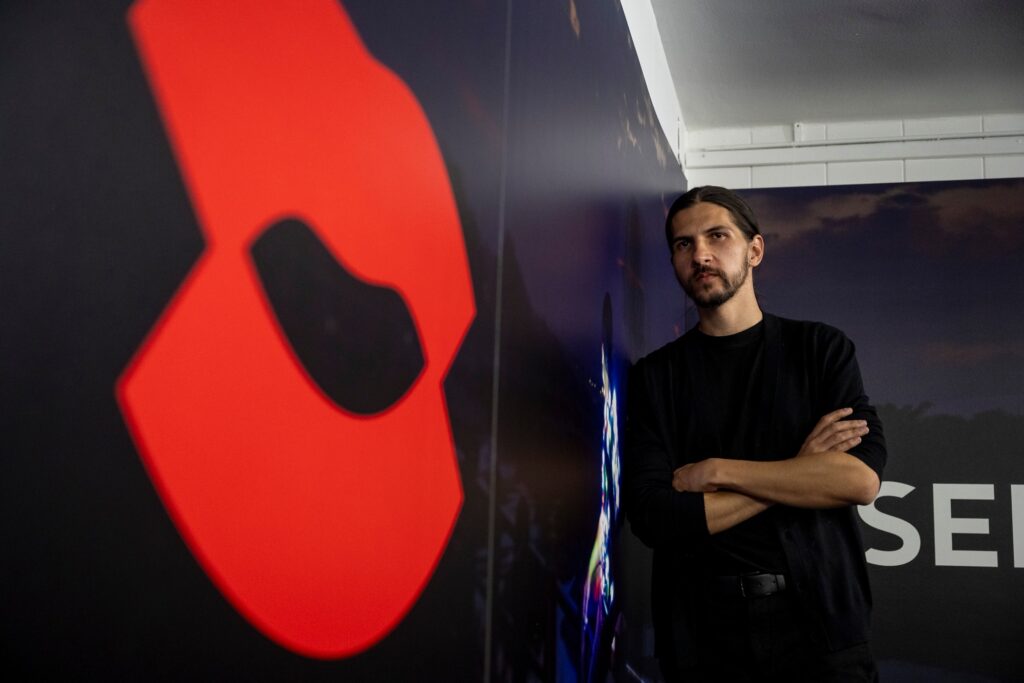
German filmmaker Sebastian Brameshuber joins a long SEMINCI tradition with London, in which existential and political questions unfold inside a car. Its protagonist, Bobby, a retired musician, travels from Vienna to Salzburg in a sort of BlaBlaCar-style car-sharing arrangement. “The film is based on my own experiences using a similar app, where you travel from A to B with people you don’t know. What fascinates me most are these fleeting encounters, the conversations and the intimacy that develops with a stranger in a car,” he explained.
Cine Gourmet: from the grape to the screen
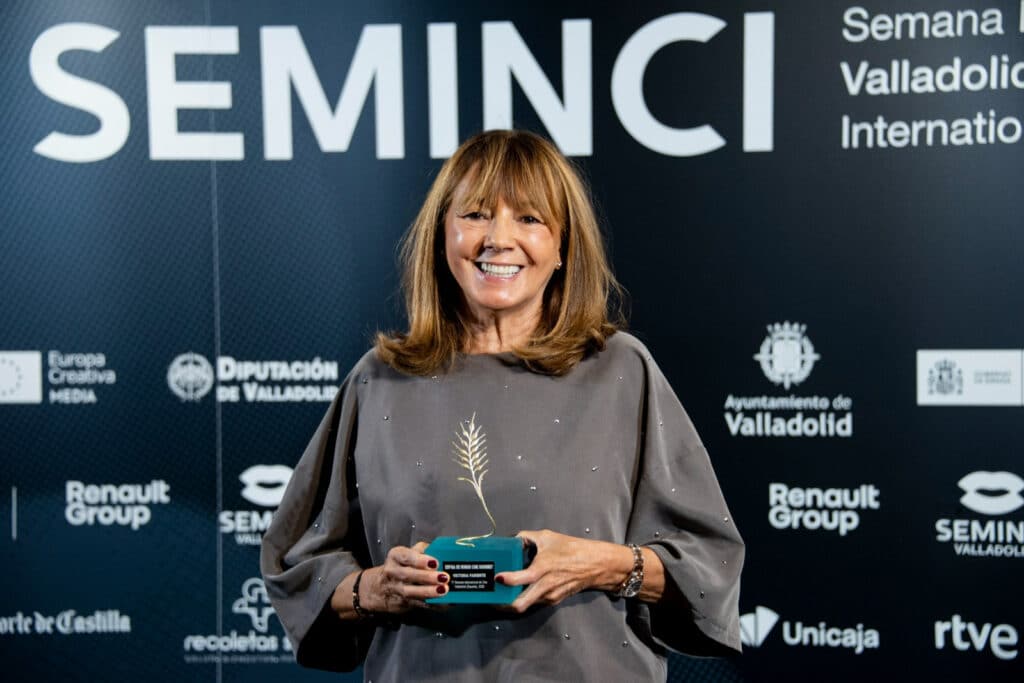
Winemaker Victoria Pariente, a leading figure in the Verdejo grape variety, received the Cine Gourmet Honorary Golden Spike Award from Enrique Pascual and Miguel Sanz, president and director respectively of the Ribera del Duero Designation of Origin Regulatory Council. She became the first woman to receive the distinction since 2014. A surprise video featuring wine industry professionals and members of her own family offered their congratulations. “Cinema and wine have a great deal in common. Cinema starts with a story, while we start with something as extraordinary as a grape. In the end, everything becomes part of our culture and our lives,” she said in an emotional speech, adding that she hoped “when we look back, I will have been the first of many”.
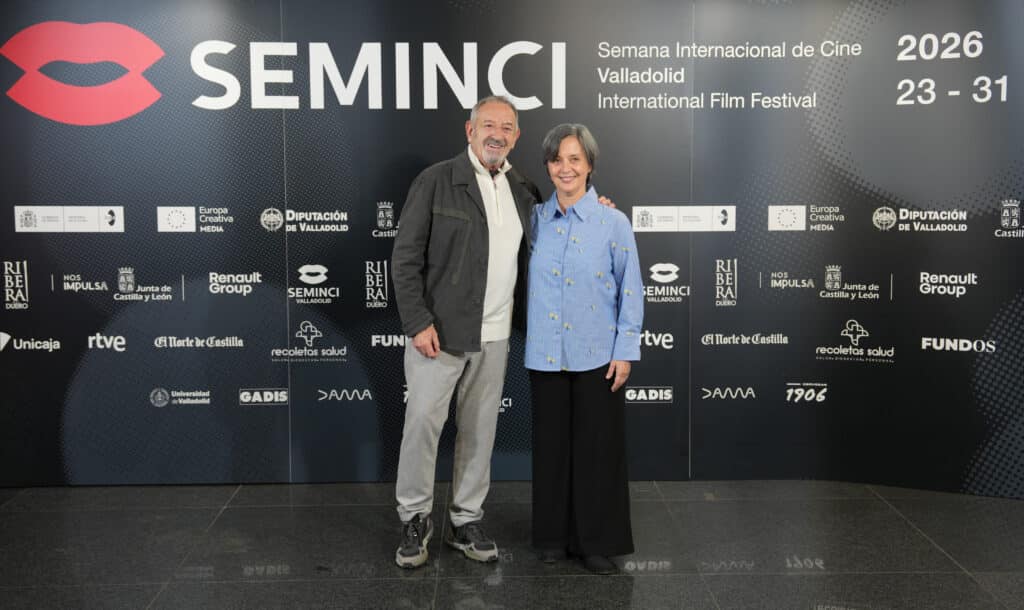
This was followed by a screening of Un tal Karlos, directed by Arantxa Aguirre, a more personal portrait of chef Karlos Arguiñano. “It isn’t exactly a gastronomic film, but rather a human one. The art of preparing a good meal has a great deal in common with the art of living. He is good at both,” the director explained. Arguiñano summed it up with his characteristic humour: “Normally, I let myself into your homes every day. Today, I’m allowing you to come into mine.”
Sound: a book exploring the art of listening
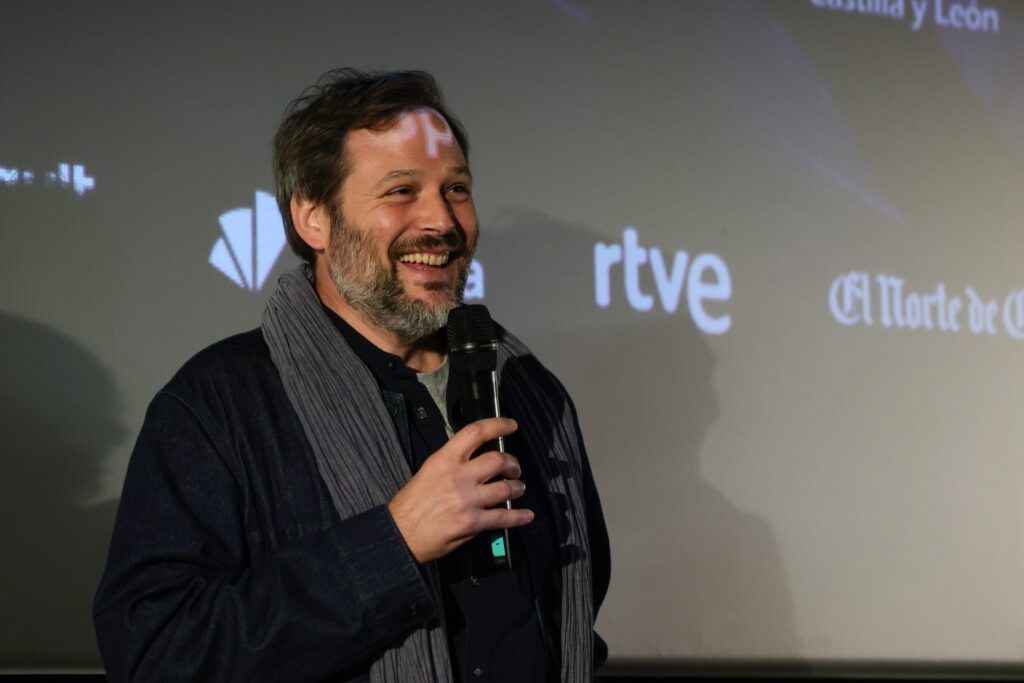
As part of Thinking (and Listening to) Cinema, the festival presented La imagen-sonido. Caligrafías sonoras y epifanías de la escucha en la historia del cine, published by the festival in collaboration with Caimán Cuadernos de Cine. Those attending included Carlos F. Heredero, the book’s coordinator, authors Carlos Losilla and José Antonio Hurtado, and sound recordist Tarn Willers. Heredero explained that the book required a collective perspective “to explore that blurred boundary we call sound cinema”. Losilla described contemporary cinema as “a place of learning”, while Hurtado, who writes about Wim Wenders, recalled that the filmmaker “always used to say that it was impossible to think about his images without music”.
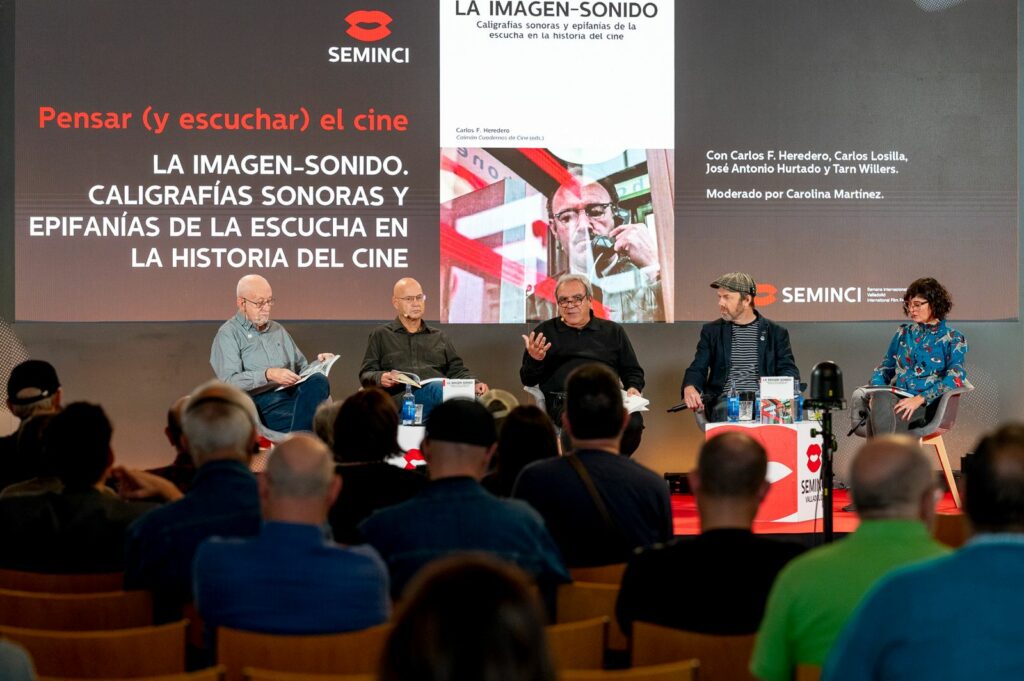
Willers, who won an Oscar for The Zone of Interest, explained how he worked with Jonathan Glazer: they had to microphone the entire house, the garden and the actors, because the director “wasn’t so interested in the dialogue as in everything happening around it, such as doors and footsteps”. He summed up the power of sound: “The eye processes images, but sound is received through the limbic system without passing through the brain, which makes our perception much more emotional.”
MERCI and Wajda with live music
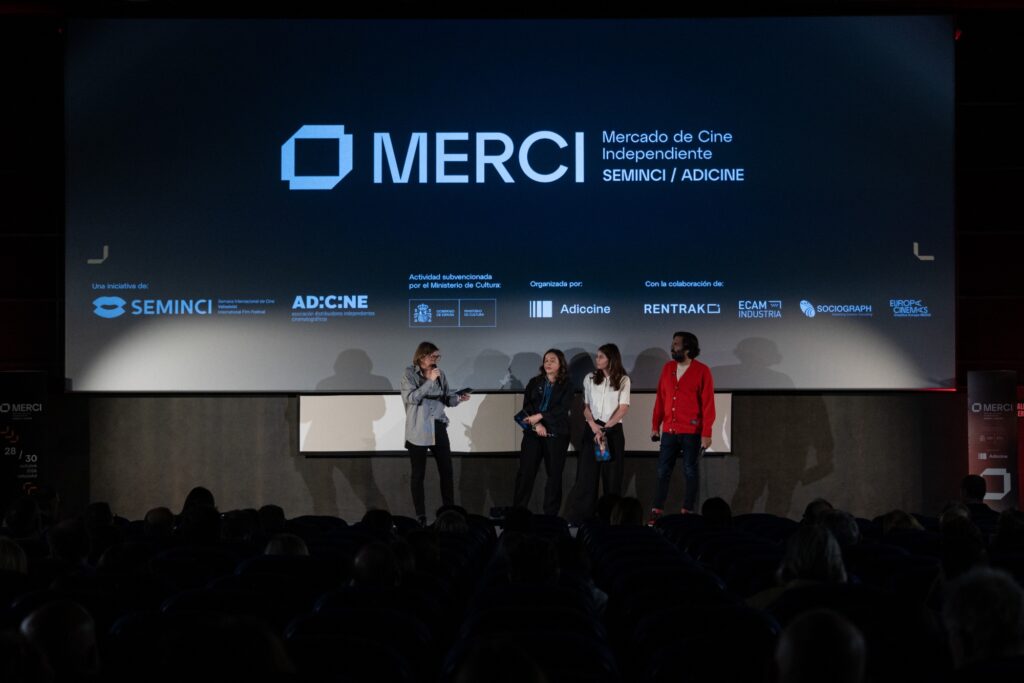
The Independent Film Market MERCI, organised in collaboration with ADICINE, opened its sixth edition at Cines Broadway, running from 28 to 30 October and bringing together more than 200 industry professionals. Mariona Viader explained the purpose of the market: “We don’t just want to show films; we want them to circulate beyond the festival. Distributors, platforms, exhibitors and film libraries are essential to ensuring that arthouse cinema reaches audiences outside festivals.” Lara Pérez Camiña celebrated the year for Spanish cinema: “ADICINE has doubled its presence at the box office”, accounting for 50% of Spanish cinema admissions through the films distributed by its members. Enrique Costa added: “Independent Spanish distributors are proving that we can bring any kind of film to audiences.”
That evening, to mark the centenary of Andrzej Wajda’s birth, Cines Broadway screened a restored version of Innocent Sorcerers (1960), accompanied by the soundtrack by Krzysztof Komeda, performed live by the Albert Karch Quintet, part of Poland’s emerging jazz scene.
SEMINCI joins the mourning
The day was overshadowed by the memory of the victims of the serious railway accident in the province of Toledo. Before the presentation of the Honorary Spike Award to Valeria Sarmiento and the Cine Gourmet gala, co-directors Mariona Viader and Javier H. Estrada expressed their sadness and extended their condolences to the victims’ families. At 8 pm, the festival joined the minute’s silence called by the Spanish Federation of Municipalities and Provinces. As a mark of respect, that day’s Seminci Noche performances at El Desierto Rojo and Bizarro were cancelled. “At SEMINCI, we share in the grief of the families,” the festival concluded.