


- The programme includes the world premiere of the restored version of Ana Mariscal’s Occidente y sabotaje, alongside works by Věra Chytilová, Liliana Cavani, Andrzej Wajda, Ildikó Enyedi, Youssef Chahine and Konrad Wolf
- The festival will dedicate a special screening to the Generation of ’27 and its connection to cinema, literature and the avant-garde, featuring the launch of Fernando Lara’s book Children of ’27: The Cinematic Writers of the Republican Generation
The ‘Memory and Utopia’ section at this 71st SEMINCI will bring together fourteen films made between 1929 and 1997 that draw on fantasy, surrealism and personal worlds to explore reality and memory. These films find in the imagination a way of viewing their era from their own perspectives, whether through the recreation of periods and events, personal memory, or a break with narrative and visual conventions. The selection brings together works by Luis Buñuel, Věra Chytilová, Liliana Cavani, Andrzej Wajda, Ildikó Enyedi, Youssef Chahine, Konrad Wolf and Ana Mariscal, amongst other filmmakers, and features newly restored versions.
Fables offering a glimpse into the present and the past
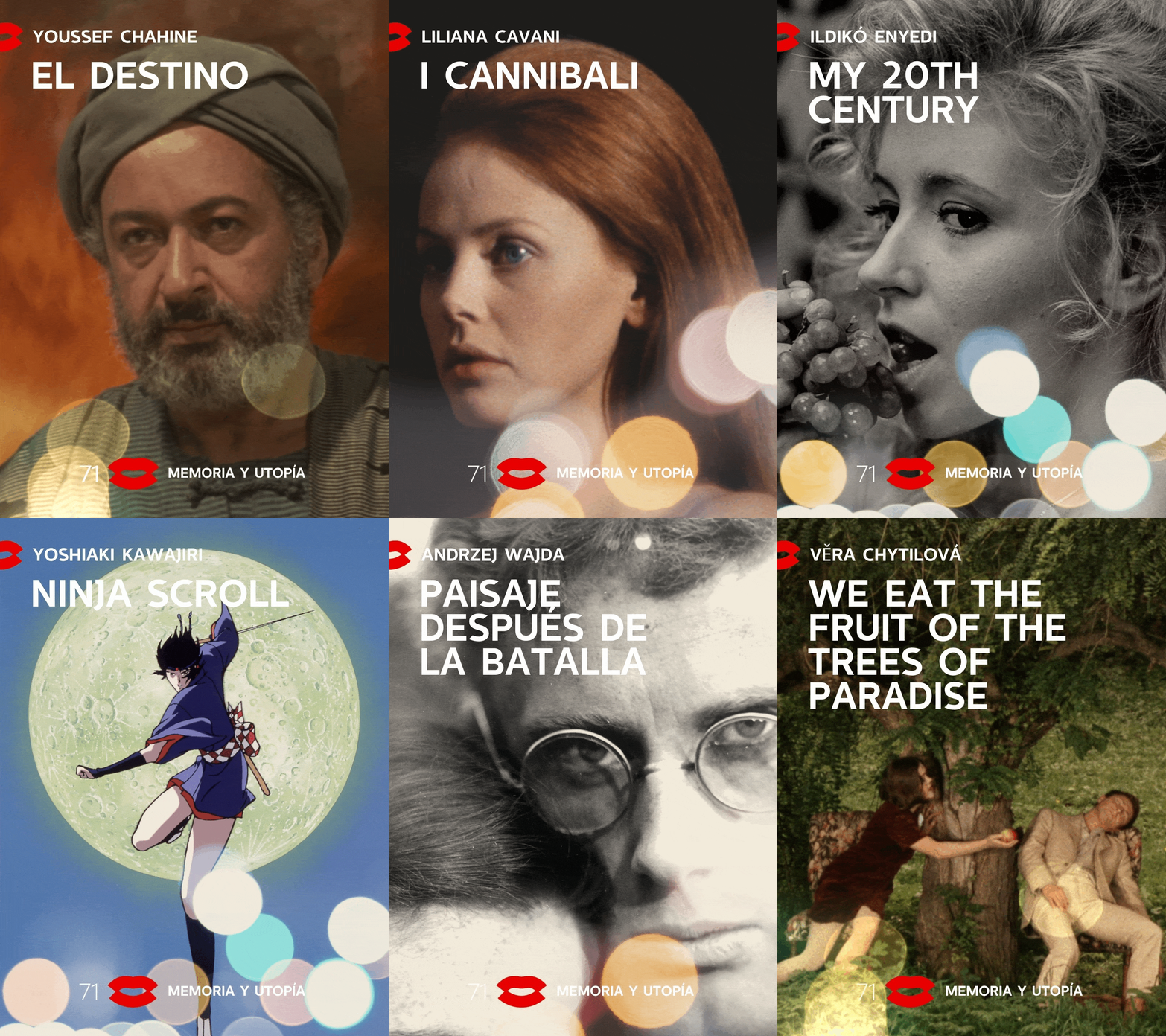
The section opens with Yoshiaki Kawajiri’s Ninja Scroll (1993), one of the films that helped introduce anime to a generation of Western audiences during the 1990s. Its portrayal of feudal Japan departs from any canonical historical reconstruction to create a fantastical universe in which Japanese mythology and elements drawn from Western action cinema converge. The film now returns in a new 4K restoration made from the original 35mm negative under Kawajiri’s own supervision.
Also drawing on fantasy, but transposing a classical myth to a totalitarian Milan of the late 1960s, Liliana Cavani constructs The Year of the Cannibals (1969) based on Sophocles’ Antigone. In a city where corpses lie in the streets because it is forbidden to bury them, the seemingly simple act of a young woman who decides to disobey becomes a form of rebellion. The print presented in this section comes from the 4K restoration carried out by Cinegrell for the Locarno Film Festival.
Ahmed Bouanani’s only feature film, The Mirage (1979), brings this imaginative freedom to post-Second World War Morocco. The story of a peasant who finds some banknotes and travels to Salé to exchange them becomes a surrealist fable about the promise of prosperity and the inequalities of a country caught between tradition and modernity. The film has been restored in 4K by the Cinémathèque Marocaine from the original 35 mm film and sound negatives.
In Destiny (1997), Youssef Chahine also draws on historical fiction to address the present. The philosopher Averroes and 12th-century Córdoba serve as the backdrop for the Egyptian filmmaker to tell a story about the defence of reason, the circulation of ideas and the clash between knowledge and fanaticism, in an adventure featuring horses, romance, music and dance. The film has been restored in 4K by Orange Studio, MISR International Films and the Cinémathèque française, with support from the CNC.
Personal memory is the starting point for Betrayal (1981) by Vibeke Løkkeberg, which reconstructs a girl’s childhood in post-war Norway whilst her family undergoes a profound rift. The film forms part of the works restored and digitised by the Norwegian National Library.
The freedom to invent other forms
Imagination becomes a tool for formal innovation in We Eat the Fruit of the Trees of Paradise (1970), Věra Chytilová’s final work before censorship curtailed her filmmaking activities. It is a free reinterpretation of the story of Adam and Eve, built around desire, knowledge, humour and mystery. SEMINCI will present the restoration undertaken by the National Film Archive in Prague.
In Goya (1971), Konrad Wolf approaches the figure of the painter from a perspective that departs from conventional biography. This production from the former German Democratic Republic examines the moment when the painter, who is connected to the court, begins to confront the violence, injustice and poverty that exist beyond it. Shot in 70 mm, the film features a new version digitally restored by the DEFA-Stiftung.
In Landscape After Battle (1970), Andrzej Wajda – restored by SF Kadr and SF Zebra studios with the support of the Polish Film Institute – turns his gaze to a pivotal moment in the Second World War, focusing on characters who have survived the concentration camps and are faced with a freedom they do not know how to live with.
In My 20th Century (1989), Ildikó Enyedi creates a luminous and free-spirited film that blends imagination, humour and fantasy to explore a time when science, new technologies and cinema seemed to herald a future open to every possibility. The film, winner of the Caméra d’Or at Cannes, has undergone a complete 4K digital restoration carried out by the Film Archive of the Hungarian National Film Fund and Filmlab.
Ana Mariscal directs and stars in Occidente y sabotaje (1962), a unique spy thriller set in Franco’s Spain, marked by the fear of infiltration, sabotage and the communist threat, and whose restored copy will have its world premiere at SEMINCI. Mariscal herself plays the leader of an underground organisation, a character who embodies a position of power that was unusual in Spanish cinema of the time. The film forms part of the Ana Mariscal archive held by the Spanish Film Archive.
The Generation of ’27, Cinema and the Avant-Garde
‘Memory and Utopia’ marks the centenary of the Generation of ’27 with a special screening focusing on the cinema that emerged from that convergence of film, literature and the avant-garde which shaped Spanish culture in the 1930s; the event will also feature the launch of the book Hijos del 27. The Film Writers of the Republican Generation, by Fernando Lara, director of Seminci between 1984 and 2004.
The session features two films from 1930 by Ernesto Giménez Caballero, which form part of the collection preserved by the Spanish Film Archive: Esencia de verbena explores festivals, streets and popular culture, whilst Noticiario del Cineclub delves into these venues and the avant-garde spirit of the era. Both blend literature, cinema and urban life with the freedom of a collage, creating a complementary portrait of the city, straddling the traditional and the modern.
The programme is rounded off with two classics by Luis Buñuel, ranging from the surrealism of Un chien andalou (1929), made in collaboration with Salvador Dalí, to the provocation of L’Age d’Or (1930), which challenges bourgeois morality and religion. The films are presented in 4K restorations carried out by the Cinémathèque française, the Spanish Film Archive and the Centre Pompidou.

- Ninja Scroll, de Yoshiaki Kawajiri
- I cannibali, de Liliana Cavani
- The Mirage, de Ahmed Bouanani
- El destino, de Youssef Chahine
- Traición, de Vibeke Løkkeberg
- We Eat the Fruit of the Trees of Paradise, de Věra Chytilová
- Goya, de Konrad Wolf
- Paisaje después de la batalla, de Andrzej Wajda
- My 20th Century, de Ildikó Enyedi
- Occidente y sabotaje, de Ana Mariscal
- Esencia de verbena, de Ernesto Giménez Caballero
- Noticiario del Cineclub, de Ernesto Giménez Caballero
- Un perro andaluz, de Luis Buñuel
- La edad de oro, de Luis Buñuel