Sharing the documentary film’s gaze
It all began in Barcelona, three decades ago, with a collective aspiration: the realisation that documentary cinema can trans- form cinematic language and dramaturgy, thereby contribut- ing to a renewal of visual and auditory styles and of the way in which cinema engages with its audiences and society.
From the outset, this collective drive highlighted the need to experiment with new hybrid forms where the boundaries between reality and its representation become blurred. It is in this way that the films we have championed over the years have opened up new avenues of expression, which have also been adopted by other filmmakers and, in many cases, em- braced as shared values.
Undoubtedly, the ‘scene setting’ –a way of organising a sequence in which the characters improvise a dialogue based on brief prior instructions from the filmmaker– allows for something distinct to be created, somewhere between anticipation and surprise. Or the use of shot/reverse shot, an element of classical cinema that takes on a new emotional dimension when transferred to documentary filmmaking. Or the redefinition of the expressive role of sound, breaking with the conventions of journalistic re- porting to create a new soundscape, which has been successfully transferred to realistic fiction cinema. Or the essential role of the editing suite, transformed into a creative laboratory, where the complexities that a documentary film cannot foresee at the time of shooting are resolved. Or, in a disruptive and remarkable way: the methodologies for working with ‘non-actors’ who can portray themselves or even go beyond themselves, providing a kind of credibility that has had a decisive influence on some of the finest fiction films that have adopted these same strategies.
The term ‘creative documentary’ is an expression that helps us to celebrate these divergent voices and to restore to the cinema of the real this sense of diversified mise-en-scène, which draws on cinematic references whilst simultaneously advancing new ones. To promote this type of cinema, we must consider the means of dissemination, alonside with a generational renewal that serves as a platform for a new pluralism where training
becomes an essential element. The aim is to share perspectives and ensure that documentary films take on a central referential role, on an equal footing with fiction, with an intrinsic value that enables them to explore the mysteries of reality.
Nine documentaries were recently named among the 25 best Catalan films of the 21st century in a Diari ARA survey of 200 experts —with three ranking in the top five. This tangible rec- ognition highlights the value of stylistic diversity and points to- ward a critical and historiographical re-examination of cinema.
Access for female documentary filmmakers
This renewal in documentary cinema is largely driven by a new generation of filmmakers who can secure public funding for their debuts without a completed script. This flexibility stems from a robust training and mentorship ecosystem that instills the confidence needed to back projects without a formal track record. Such an approach has transformed Catalan and Span- ish documentary filmmaking, yielding groundbreaking, interna- tionally acclaimed festival hits fueled by the conviction to create something genuinely unique from the very start.
In parallel, this movement of renewal and generational collab- oration has driven one of the most radical and transformative shifts: the entry of women filmmakers into various creative roles within documentary cinema, including directors, producers, screenwriters, editors, cinematographers, and sound designers. Championed by various cultural sectors —particularly women filmmakers’ associations— this development has introduced a distinctive value to the medium. In the specific case of docu- mentary film, rectifying this injustice has led to the emergence of deeply compelling approaches. This gender perspective, which was pioneered right here among us women film profes- sionals, has steadily established itself over the years.
Among these genuine contributions to documentary film by women, the rise of female filmmakers investigating family mys- teries is highly significant, giving this first-person approach a political dimension —a resonance where the ‘I’ frequently trans- forms into ‘we’. This international trend reflects an investigative model that seeks not an ultimate truth, but rather to illuminate the gray areas that directly involve each film creator. Several masterpieces of contemporary documentary are rooted in this individual impulse, which boldly embraces risk to ultimately become a collective drive.
Other ethical and aesthetic movements that have flourished alongside the path toward gender equality include a deep inter- est in otherness and an exploration of communities that have previously lacked a voice of their own. As a natural extension of this expressive intent, the associations most active in promoting and ensuring the presence of women filmmakers have drawn attention to the creative silence of many communities that lack equal access to audiovisual exposure in cultural media. This fla- grant inequality demands coordinated action to integrate these voices into a more inclusive culture. Here, documentary cinema plays a revelatory role —as demonstrated by the international recognition of the first films we have collectively championed in response to this challenge.
Impact and Sustainability
A defining feature of many documentary films is their ability to become public spaces, as they naturally contain and spark diverse debates. The finest creative documentaries possess a far-reaching resonance: they are defined not by their subject matter, but by their capacity to turn the film itself into a beacon, intervening in social discourse through their artistic contribution.
This conviction demands a fresh, contemporary approach to how documentary cinema engages with its potential audi- ences, and how this thought-provoking power contributes to the intrinsic value of each film. In contrast to traditional mod- els that reduced a film’s release strictly to quantitative metrics, contemporary documentary stands at the forefront of a new way of defining value —where community impact and the
power to transform perspectives become a potential that must be tangibly measured.
This implies incorporating audience design into these new value standards —understood not as a market segmentation tool, but as an ethical, relational practice interwoven with both creation and sustainability from the very start. Audiences are not passive end-consumers, but communities deeply embedded in the film’s aesthetic, political, and narrative logic. Far from seeing the public as a static or predictive category, audience design functions as an ecology of relationships that accom- panies, informs, and feeds back into the creative process. In this way, spaces of listening, presence, and transformation are generated, where narrative and production decisions are shaped from the outset by the affective and cultural map of the audiences they wish to gather.
In this new paradigm, sustainability is not introduced during the production stage as an external or certifiable requirement; instead, it inhabits the project from the very first creative ges- ture, transforming character selection criteria, choice of loca- tions, visual language, and shooting methods from within. The audience plan acts not as a marketing tool, but as a sounding board on which the bonds the film seeks to activate are antic- ipated. The film is not addressed to audiences: it is built from them, within them, and with them.
In the case of documentary film, sustainability requires an expanded sensitivity: it is not merely about reducing the car- bon footprint, but about establishing affectively and ethically consistent relationships with the territories and subjects filmed. These new objectives define the transformations we are ad- dressing within transmission systems.
Jordi Balló y Eva Vila Master’s Degree in Creative Documentary, UPF-BSM
FILMS SUPPORTED THROUGH THE MASTER’S PROGRAM IN CREATIVE DOCUMENTARY
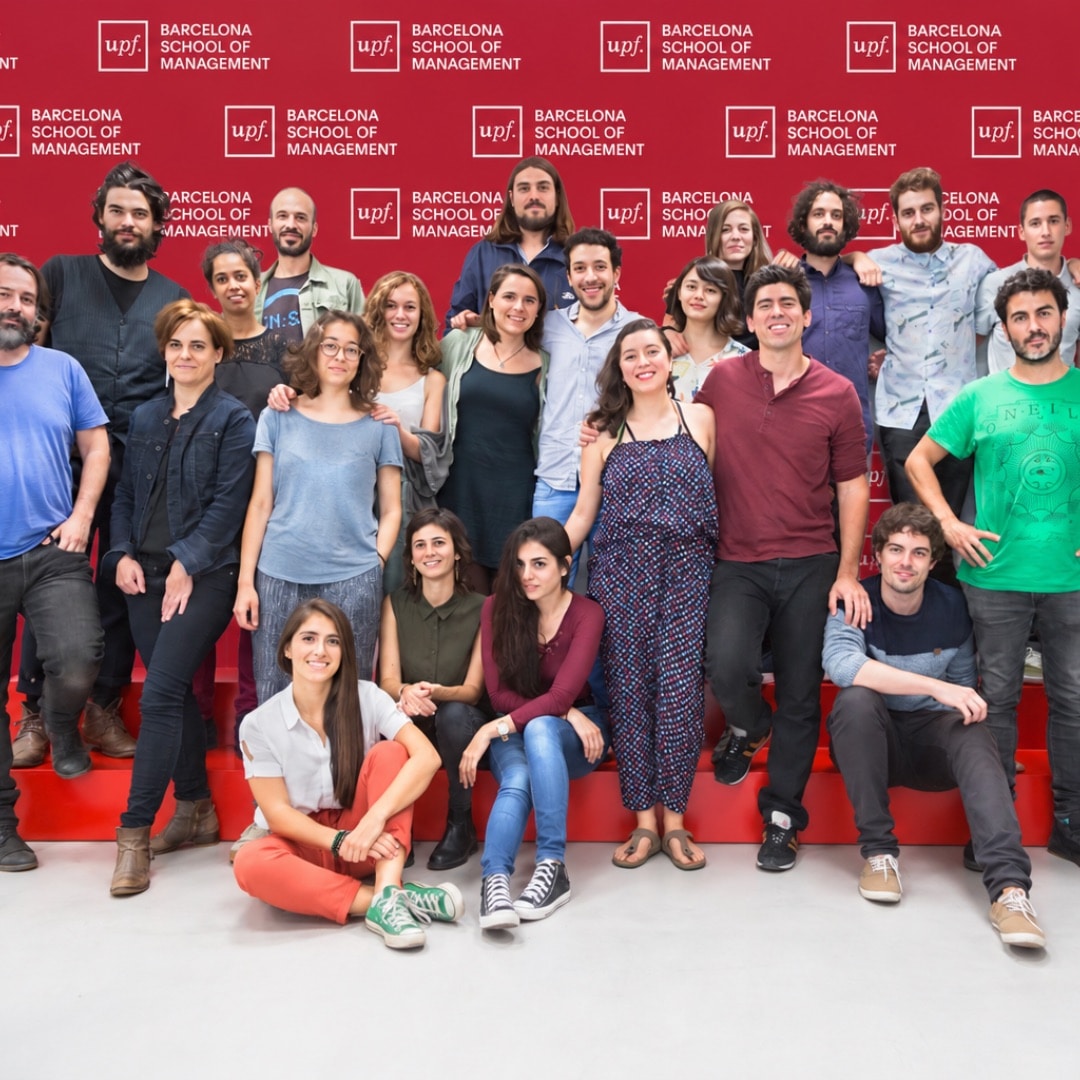
Each edition of the master’s program promotes three documentary films that each filmmaker shares with the students at various stages, always in collaboration with independent production companies. The result is a collection of titles that contribute to the centrality of documentary cinema and its advancement through innovative film narratives.
- 1. ‘Monos como Becky’ (Joaquim Jordà y Núria Villazán, 1999)
- 2. ‘Buenaventura Durruti, anarquista’ (Jean-Louis Comolli, 2000)
- 3. ‘En construcción’ (José Luis Guerin, 2001)
- 4. ‘Cravan vs Cravan’ (Isaki Lacuesta, 2002)
- 5. ‘De nens’ (Joaquim Jordà, 2003)
- 6. ‘El cielo gira’ (Mercedes Álvarez, 2004)
- . ‘Veinte años no es nada’ (Joaquim Jordà, 2004)
- 8. ‘Tierra negra’ (Ricardo Íscar, 2004)
- 9. ‘Aguaviva’ (Ariadna Pujol, 2006)
- 10. ‘Memoria negra’ (Xavier Montanyà, 2006)
- 11. ‘Diario argentino’ (Lupe Pérez, 2006)
- 12. ‘La leyenda del tiempo’ (Isaki Lacuesta, 2006)
- 13. ‘Dies d’agost’ (Marc Recha, 2006)
- 14. ‘Los condenados’ (Isaki Lacuesta, 2009)
- 15. ‘Morir de dia’ (Laia Manresa y Sergi Dies, 2010)
- 16. ‘Cuchillo de palo’ (Renate Costa, 2010)
- 17. ‘Hollywood talkies’ (Óscar Pérez y Mia de Ribot, 2011)
- 18. ‘Mercado de futuros’ (Mercedes Álvarez, 2011)
- 19. ‘Al fossat (El foso)’ (Ricardo Íscar, 2012)
- 20. ‘Volar’ (Carla Subirana, 2013)
- 21. ‘La plaga’ (Neus Ballús, 2013)
- 22. ‘Bajarí’ (Eva Vila, 2013)
- 23. ‘Demonstration’ (Victor Kossakovsky, 2013)
- 24. ‘Cartas a María’ (Maite García Ribot, 2015)
- 25. ‘La substància’ (Lluís Galter, 2016)
- 26. ‘Penèlope’ (Eva Vila, 2017)
- 27. ‘O que arde’ (Oliver Laxe, 2019)
- 28. ‘La malaltia-docudrama escènic’ (Juan Carlos Martel, 2021)
- 29. ‘Sis dies corrents’ (Neus Ballús, 2021) Neus Ballús
- 30. ‘Aire’ (Ricardo Íscar, 2022)
- 31. ‘Sica’ (Carla Subirana, 2023)
- 32. ‘Samsara’ (Lois Patiño, 2023)
- 33. ‘Tardes de soledad’ (Albert Serra, 2024)
- 34. ‘Les culpables’ (Marta Duran, 2026)
- 35. ‘La noche de la infancia’ (Xisi Sofía Ye Chen, 2026)
- 36. ‘A través del Carmel 20.26’ (Claudio Zulián)
- 37. ‘Barcelona’ (Eva Vila)
- 38. ‘La Unión’ (Cordelia Alegre)
- 39. ‘Natàlia’ (Carlota Subirós)
- 40. ‘Allò que no va ser. El cinema pendent de Joaquim Jordà’ (Cristina Rubio)
- 41. ‘El país de los ciegos’ (Pablo Maqueda)
- 42. ‘Cossos al buit’ (Alba Bresolí)