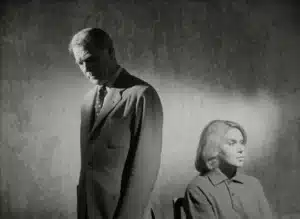
Following a documentary-style prologue on the habits of the scorpion, a gang of bandits discover a group of archbishops praying on a cliff. The founding of Imperial Rome, celebrated at the very spot where the clergy were praying, is interrupted by the amorous escapades of a couple who are eventually separated. The man is taken to prison but manages to escape and takes refuge at his beloved’s home. During a party, the couple attempt to consummate their passion, but to no avail. Finally, the survivors of a criminal orgy, amongst whom is the Duke of Blangis, leave Selliny Castle.
Luis Buñuel
Calanda, 1900 – Mexico City, 1983. A master of surrealism, he was one of the most influential directors in the history of cinema. In 1917, he arrived at the Residencia de Estudiantes in Madrid, where he became friends with Federico García Lorca and Salvador Dalí. After graduating in History, he moved to Paris in 1925, where he enrolled at the Film Academy and began working as a production assistant to Jean Epstein. In 1929, he made his film debut with ‘Un chien andalou’ (1929), followed by ‘L’Age d’Or’ (1930). Following the Spanish Civil War, in 1946 he went into exile in Mexico, where he directed more than fifteen films, including works such as ‘The Young and the Damned’ (1950, Best Director at Cannes, where he was awarded the National Arts Prize in 1977). His filmography includes awards such as the Palme d’Or at Cannes (‘for ‘Viridiana’, in 1961), the FIPRESCI Prize at Cannes for ‘The Exterminating Angel’ (1962), the Golden Lion at Venice for ‘Belle de Jour’ (1967) and the Oscar for Best Foreign Language Film for ‘The Discreet Charm of the Bourgeoisie’ (1972), amongst many others.
DIRECTOR
Luis Buñuel
SCREENPLAY
Luis Buñuel, Salvador Dalí
CINEMATOGRAPHY
Albert Duverger
EDITOR
Luis Buñuel
SOUND
Peter Paul Brauer
MUSIC
Luis Buñuel, Georges Van Parys
PRODUCTION
Charles de Noailles, Marie-Laure de Noailles
CAST
Gaston Modot, Lya Lys, Caridad de Laberdesque, Lionel Salem, Max Ernst, Madame Noizet, Liorens Artryas, Duchange